
There is no universal tire pressure for every 215/75R17.5 commercial tire.
This size is available with different load indexes, load ranges and applications. A 215/75R17.5 Load Range G steer or all-position tire may have a maximum reference near 102 PSI, while a Load Range J trailer tire can be rated to 130 PSI. Those specifications are not interchangeable.
The correct cold pressure must be selected from the table that matches the exact sidewall marking, then checked against actual axle load, single or dual fitment, rim and wheel limits, speed and service conditions.
215/75R17.5 Tire Pressure Quick Answer
A practical answer begins by reading the complete specification:
- Load Range G steer/all-position example: up to approximately 1,700 kg per tire in single fitment and 1,600 kg per tire in dual fitment at 102 PSI.
- Load Range J trailer example: up to approximately 2,240 kg per tire in single fitment and 2,120 kg per tire in dual fitment at 130 PSI.
- 128/126 service description example: use the load–inflation progression for load index 128 in single fitment and 126 in dual fitment.
These are manufacturer references, not universal pressure recommendations. Do not use 130 PSI simply because it appears in a table for the same nominal tire size.
215/75R17.5 Load Range G vs Load Range J
| Specification Example | Typical Position/Application | Maximum Single Load | Maximum Dual Load | Maximum Reference Pressure |
|---|---|---|---|---|
| Load Range G | Steer/all-position; regional and urban delivery | 1,700 kg per tire | 1,600 kg per tire | 102 PSI |
| Load Range J | Trailer; regional, line-haul, low-bed or high-cube applications | 2,240 kg per tire | 2,120 kg per tire | 130 PSI |
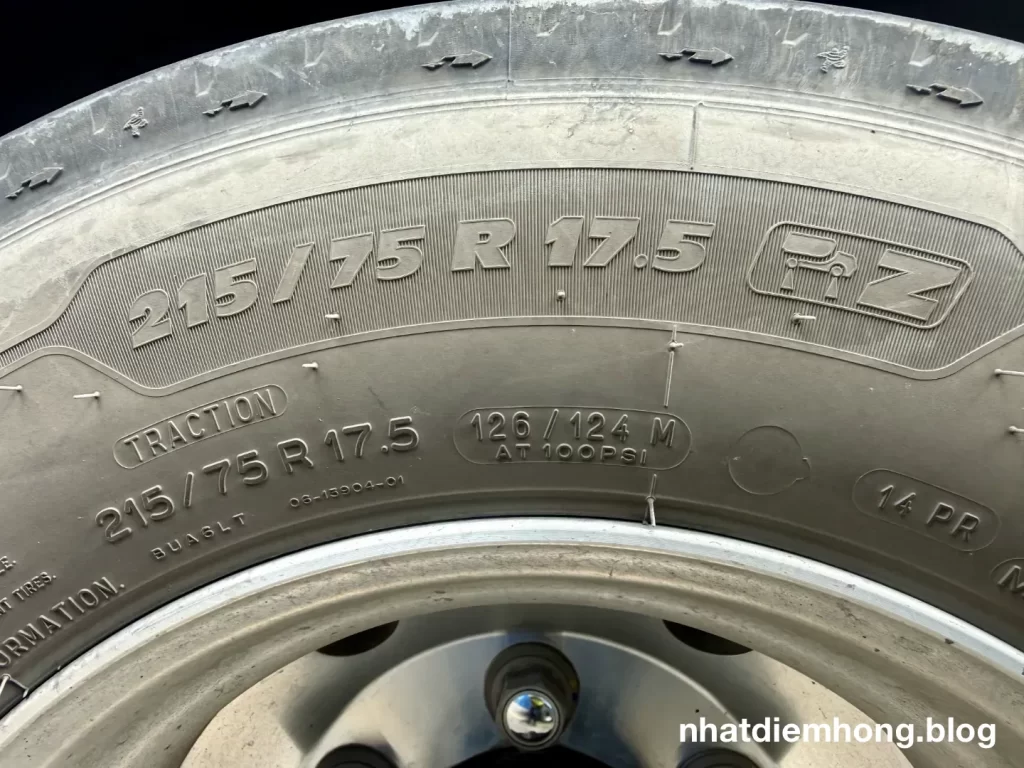
The difference is not merely “more pressure.” The Load Range J trailer casing, load rating and approved operating envelope are different. The tire and wheel assembly must be suitable for the higher pressure.
215/75R17.5 Load–Inflation Table for 128/126
The following manufacturer reference shows load capacity per axle. Single assumes two tires per axle; dual assumes four tires per axle.
| Cold Pressure | Single Axle Load (LI 128) | Approx. Load per Single Tire | Dual Axle Load (LI 126) | Approx. Load per Dual Tire |
|---|---|---|---|---|
| 65 PSI | 2,390 kg | 1,195 kg | 4,515 kg | 1,129 kg |
| 73 PSI | 2,600 kg | 1,300 kg | 4,915 kg | 1,229 kg |
| 80 PSI | 2,805 kg | 1,403 kg | 5,305 kg | 1,326 kg |
| 87 PSI | 3,010 kg | 1,505 kg | 5,685 kg | 1,421 kg |
| 94 PSI | 3,210 kg | 1,605 kg | 6,060 kg | 1,515 kg |
| 102 PSI | 3,405 kg | 1,703 kg | 6,430 kg | 1,608 kg |
| 109 PSI | 3,600 kg | 1,800 kg | 6,800 kg | 1,700 kg |
Use this table only when the tire’s sidewall and manufacturer data match the 128/126 specification. Other 215/75R17.5 products may carry 126/124, 135/133 or another service description.
Load Range G Pressure by Axle Load
This Load Range G reference is for a steer/all-position specification with a maximum of 102 PSI.
| Cold Pressure | Single Axle Load | Dual Axle Load |
|---|---|---|
| 55 PSI | 2,090 kg | 3,930 kg |
| 60 PSI | 2,220 kg | 4,170 kg |
| 65 PSI | 2,390 kg | 4,490 kg |
| 70 PSI | 2,510 kg | 4,730 kg |
| 75 PSI | 2,680 kg | 5,050 kg |
| 80 PSI | 2,800 kg | 5,280 kg |
| 85 PSI | 2,970 kg | 5,580 kg |
| 90 PSI | 3,090 kg | 5,810 kg |
| 95 PSI | 3,240 kg | 6,110 kg |
| 100 PSI | 3,360 kg | 6,330 kg |
| 102 PSI maximum reference | 3,400 kg | 6,400 kg |
Load Range J Trailer Tire Pressure
Some 215/75R17.5 tires are purpose-built trailer products. The Load Range J reference below extends to 130 PSI and materially higher axle loads.
| Cold Pressure | Single Axle Load | Dual Axle Load |
|---|---|---|
| 85 PSI | 3,200 kg | 6,050 kg |
| 90 PSI | 3,330 kg | 6,290 kg |
| 95 PSI | 3,500 kg | 6,620 kg |
| 100 PSI | 3,620 kg | 6,860 kg |
| 105 PSI | 3,750 kg | 7,090 kg |
| 110 PSI | 3,910 kg | 7,410 kg |
| 115 PSI | 4,040 kg | 7,640 kg |
| 120 PSI | 4,200 kg | 7,950 kg |
| 125 PSI | 4,320 kg | 8,180 kg |
| 130 PSI | 4,480 kg | 8,480 kg |
How to Calculate Pressure from Actual Axle Load
- Weigh the axle in its normal operating condition.
- Identify whether the axle uses single or dual tires.
- Read the complete sidewall marking, including load index/load range.
- Select the matching manufacturer table.
- Choose a cold pressure whose published axle capacity is at least the measured axle load.
- Confirm tire, rim and wheel pressure limits before setting a fleet target.
Example: Load Range G steer axle
If a steer axle weighs 3,050 kg, the Load Range G table shows 85 PSI supports 2,970 kg and is insufficient, while 90 PSI supports 3,090 kg. The next suitable table value is approximately 90 PSI cold.
Example: Load Range J trailer axle
If a dual-equipped trailer axle weighs 7,500 kg, 110 PSI supports about 7,410 kg and is insufficient. The next table step, 115 PSI, supports approximately 7,640 kg. The table therefore indicates approximately 115 PSI cold, subject to the exact tire and wheel approvals.
What 128/126 Means
In a service description such as 128/126, the first load index normally applies in single configuration and the second in dual configuration. The difference is why a dual assembly must not be calculated from the single rating.
For help reading the remaining markings, see our truck tire sidewall markings guide.
Important 17.5-Inch Wheel and Rim Limits
A higher-load trailer tire does not automatically authorize higher pressure in the existing wheel. The actual load and inflation pressure must not exceed the wheel manufacturer’s maximum conditions. Verify approved rim width, wheel pressure rating, valve and component compatibility.
Common 215/75R17.5 Pressure Errors
- Using a Load Range J trailer chart for a Load Range G steer tire.
- Assuming 130 PSI is correct for every 215/75R17.5 tire.
- Reading maximum sidewall pressure as the required operating pressure.
- Using the single load index for a dual assembly.
- Ignoring the wheel pressure limit.
- Setting pressure without measuring actual axle load.
For a broader manufacturer comparison, see the Goodyear truck tire pressure chart. For fleet inspection procedures and leakage control, see truck tire pressure management.
215/75R17.5 manufacturer comparison
Bridgestone, Continental and Sailun data show that this size can carry materially different service descriptions. Load Range, load index, speed symbol and application must be read together.
| Manufacturer/product | Specification | Application | Maximum single load | Maximum dual load | Published endpoint |
|---|---|---|---|---|---|
| Bridgestone M729 | Load Range F only | Truck drive pattern | 1,700 kg | 1,600 kg | 100 PSI |
| Bridgestone R238 | Load Range G only | Truck, exact position per product | 1,700 kg | 1,600 kg | 100 PSI in the referenced table |
| Bridgestone R238 | Load Range H only | Higher-capacity truck specification | 2,180 kg | 2,060 kg | 125 PSI |
| Continental LS3 / LD3 | 126/124M | Steer or drive | 1,700 kg | 1,600 kg | Use the matching Continental table |
| Sailun SAR1 truck | 128/126M, 16 PR | Regional steer/all-position | 1,800 kg | 1,700 kg | 110 PSI (750 kPa) |
| Sailun SAR1 trailer | 135/133L, 16 PR | Regional trailer | 2,180 kg | 2,060 kg | 125 PSI (860 kPa) |
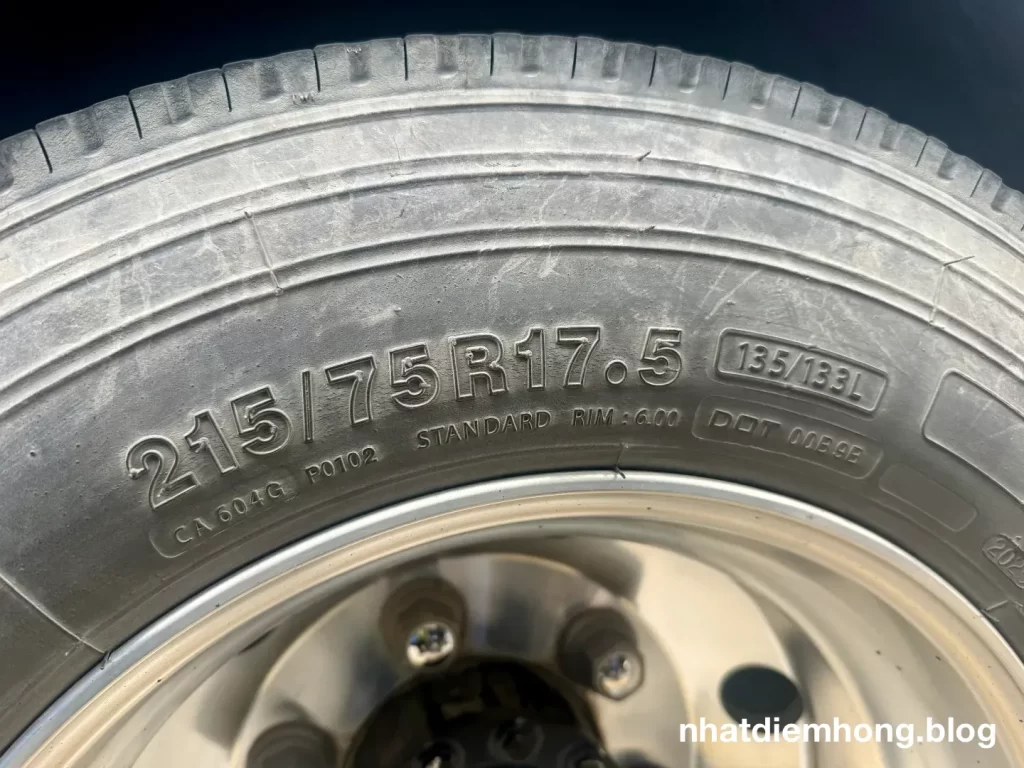
Trailer approval cannot be inferred from the higher pressure alone. Confirm the exact tread pattern and manufacturer application before fitting the tire or selecting pressure.
Final Takeaway
The correct 215/75R17.5 pressure depends on more than size. A Load Range G steer/all-position tire and a Load Range J trailer tire can share the same nominal dimensions while requiring different load tables and operating limits.
Use this sequence: sidewall specification → application and fitment → actual axle load → matching manufacturer table → cold pressure → wheel and rim verification.
Related pressure guides
Frequently Asked Questions
There is no universal PSI. Match the exact load index or load range to the manufacturer’s table, then select cold pressure according to actual axle load and single or dual fitment.
102 PSI can be the maximum reference for certain Load Range G or specific service-description products, but it is not automatically the required operating pressure for every vehicle.
Some Load Range J trailer tires are rated to 130 PSI. The tire, rim, wheel, valve and other components must all be approved for that pressure. Do not apply the Load Range J table to a Load Range G tire.
Yes. Manufacturers offer 215/75R17.5 trailer products, including higher-load specifications intended for regional, line-haul, low-bed or high-cube trailer applications.
The first load index normally applies in single configuration and the second in dual configuration. Always verify the exact manufacturer’s specification and speed symbol.
Nhat Diem Hong

