

Truck tire sidewall markings may appear to be nothing more than a series of numbers, letters, and symbols, but each one conveys essential information about a tire’s specifications and intended use. From tire size and load index to the DOT code, speed rating, and maximum inflation pressure, these markings help determine whether a tire is suitable for a particular vehicle and application.
For commercial fleets and owner-operators, understanding truck tire sidewall markings is crucial for selecting the right tire, maintaining proper inflation, and operating within safe load limits. Looking only at the tire size while overlooking details such as load range or the DOT date code can lead to premature wear, reduced performance, safety risks, and unnecessary operating costs.
This guide explains how to read truck tire sidewall markings step by step, covering the most important codes and symbols you are likely to encounter. By learning what each marking means, you can make better tire decisions and identify potential issues before they turn into costly failures or downtime.
What Information Is Found on a Truck Tire Sidewall?
A truck tire sidewall contains much more than just the tire size. It serves as a permanent reference that identifies the tire’s specifications, performance limits, and regulatory information, helping fleet managers, technicians, and drivers select and operate the tire correctly.
Depending on the tire model and manufacturer, you may find the following information on the sidewall:
Tire size
Tire size – Indicates the tire’s dimensions and fitment (for example, 295/80R22.5, 11R22.5, 215/75R17.5).
Construction type – Indicates how the tire is built. Most modern commercial truck tires use radial construction, identified by the letter “R” in the size designation (for example, 295/75R22.5). If you see a hyphen (“-”) instead of an “R”—such as 10.00-20—it typically indicates a bias-ply tire, which uses a different internal construction and is more common in certain off-road or specialty applications.
Rim diameter – Specifies the wheel size the tire is designed to fit, measured in inches (for example: 17.5, 19.5, 22.5).
Load Index & Speed Index
Load Index (Single/Dual) – Indicates the tire’s maximum load capacity under specified conditions. On many commercial truck tires, it appears as two numbers separated by a slash (for example, 152/148). The first number is the load index for single-tire use on an axle, while the second applies to dual-tire use (two tires mounted side by side). The dual rating is typically lower because it reflects the tire’s certified load capacity in a dual configuration.
Speed Index – Defines the maximum speed at which the tire can safely carry its rated load. For commercial vehicles, this rating ensures the fleet operates within safe mechanical limits during highway transit. For instance, a tire with a speed symbol L is certified for a maximum safe speed of 120 km/h (75 mph), making it ideal for standard long-haul freight, while a tire marked with an M rating pushes that limit to 130 km/h (81 mph), a specification frequently required for modern high-speed expressways and passenger coaches.
| Speed Symbol | Speed (km/h) | Speed (mph) |
|---|---|---|
| F | 80 | 50 |
| G | 90 | 56 |
| J | 100 | 62 |
| K | 110 | 68 |
| L | 120 | 75 |
| M | 130 | 81 |
| N | 140 | 87 |
| P | 150 | 93 |
| Q | 160 | 99 |
| R | 170 | 106 |
| S | 180 | 112 |
| T | 190 | 118 |
Load Range
Load Range / Ply Rating – Indicates the tire’s structural strength and maximum inflation capability. While the older Ply Rating (PR) system counted actual physical fabric layers (e.g., 16PR meant 16 physical plies), modern commercial tires utilize high-strength steel belts and advanced synthetics to achieve those same capacities with far fewer layers. Consequently, Load Range (designated by letters like G, H, or J) is now the preferred standard, identifying a tire’s equivalent load classification and inflation limits rather than its construction. For instance, a Load Range H truck tire does not contain 16 physical plies, but it delivers the exact strength and performance of a traditional 16 PR tire.
| Load Range | Ply Rating |
|---|---|
| A | 2 |
| B | 4 |
| C | 6 |
| D | 8 |
| E | 10 |
| F | 12 |
| G | 14 |
| H | 16 |
| J | 18 |
| L | 20 |
| M | 22 |
| N | 24 |
Tread pattern
While a tire’s tread pattern name (such as X Multi Energy) is stamped boldly on the sidewall, most fleet operators mistake it for a mere marketing label. In reality, it is a critical technical indicator that dictates exactly how and where the tire must be operated.
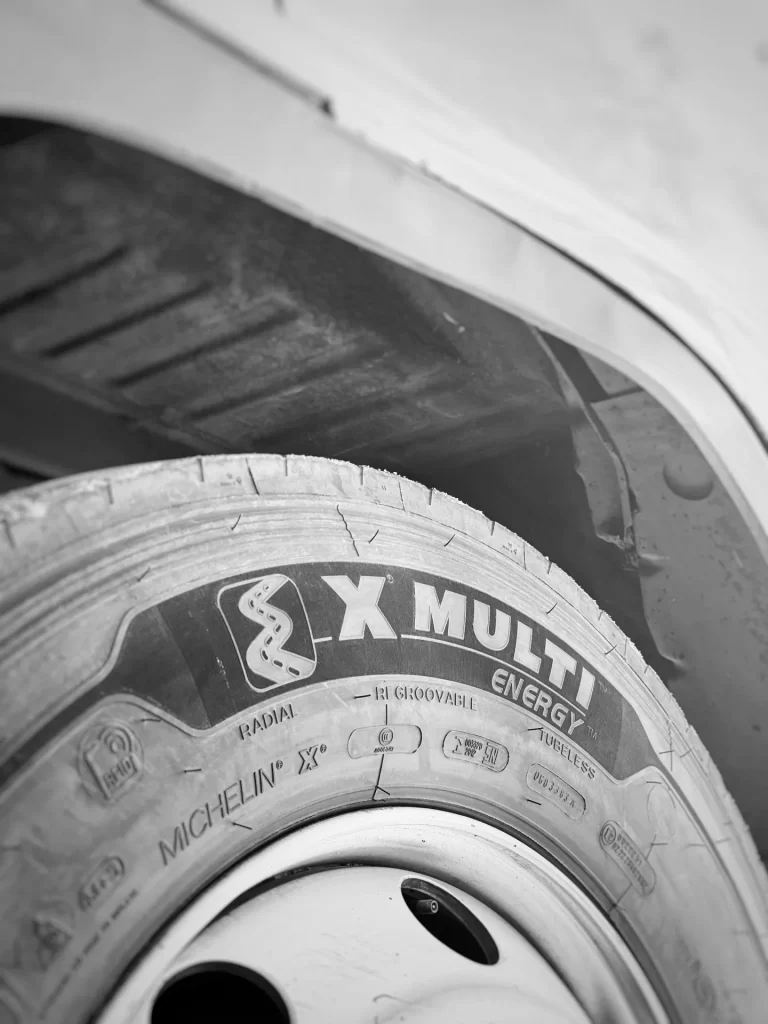
Reading the tread pattern name reveals three operational facts:
- Designated Axle Position: The pattern design determines placement. Straight vertical grooves (rib-style) provide steering stability for Steer axles; chunky block or lug designs deliver traction for Drive axles; and reinforced shoulders withstand heavy turning stress on Trailer axles.
- Application Terrain: Smooth, shallow grooves optimize fuel efficiency during highway Long-Haul transit, whereas rugged, deep-block patterns provide cut-and-chip resistance for harsh On/Off-Road construction sites.
- Specialized Fleet Capabilities: Take the Michelin X Multi Energy in Figure 1 as an example. The word “Multi” confirms the tread compound is engineered to endure regional scrubbing, turning, and braking, while “Energy” denotes ultra-low rolling resistance for high-speed highway fuel economy.
Two truck tires with the same size, load range, and load index can deliver very different fuel economy and traction simply because they use different tread patterns and compounds.
Note: Every tire manufacturer utilizes a unique naming convention for their tread patterns. To determine if the specific tire line you are running is perfectly optimized for your fleet’s application, always consult your local authorized dealer or review the technical documentation provided directly by the tire manufacturer.
Maximum Load & Maximum inflation pressure
Maximum load – States the highest permissible weight the tire can safely carry when properly inflated. On commercial truck tires, this is tied directly to the dual load index markings; for example, a tire marked with a 152/149 load index means it can carry a maximum of 3,550 kg (7,830 lbs) when used as a single tire on an axle, but drops to 3,250 kg (7,160 lbs) per tire when mounted in a dual configuration side-by-side.
| Load Index | Kg | Lbs. |
|---|---|---|
| 119 | 1360 | 3000 |
| 120 | 1400 | 3085 |
| 121 | 1450 | 3195 |
| 122 | 1500 | 3305 |
| 123 | 1550 | 3415 |
| 124 | 1600 | 3525 |
| 125 | 1650 | 3640 |
| 126 | 1700 | 3750 |
| 127 | 1750 | 3860 |
| 128 | 1800 | 3970 |
| 129 | 1850 | 4080 |
| 130 | 1900 | 4190 |
| 131 | 1950 | 4300 |
| 132 | 2000 | 4410 |
| 133 | 2060 | 4540 |
| 134 | 2120 | 4675 |
| 135 | 2180 | 4805 |
| 136 | 2240 | 4940 |
| 137 | 2300 | 5070 |
| 138 | 2360 | 5205 |
| 139 | 2430 | 5355 |
| 140 | 2500 | 5510 |
| 141 | 2575 | 5675 |
| 142 | 2650 | 5840 |
| 143 | 2725 | 6005 |
| 144 | 2800 | 6175 |
| Load Index | Kg | Lbs. |
|---|---|---|
| 145 | 2900 | 6395 |
| 146 | 3000 | 6610 |
| 147 | 3075 | 6780 |
| 148 | 3150 | 6940 |
| 149 | 3250 | 7160 |
| 150 | 3350 | 7390 |
| 151 | 3450 | 7610 |
| 152 | 3550 | 7830 |
| 153 | 3650 | 8050 |
| 154 | 3750 | 8270 |
| 155 | 3875 | 8540 |
| 156 | 4000 | 8820 |
| 157 | 4125 | 9090 |
| 158 | 4250 | 9370 |
| 159 | 4375 | 9650 |
| 160 | 4500 | 9920 |
| 161 | 4625 | 10200 |
| 162 | 4750 | 10500 |
| 163 | 4875 | 10700 |
| 164 | 5000 | 11000 |
| 165 | 5150 | 11400 |
| 166 | 5300 | 11700 |
| 167 | 5450 | 12000 |
| 168 | 5600 | 12300 |
| 169 | 5800 | 12800 |
| 170 | 6000 | 13200 |
The “MAX PRESS” marking indicates the absolute highest amount of cold inflation pressure the tire can safely hold, usually measured in PSI (Pounds per Square Inch) or kPa (Kilopascals). It is vital to understand that this number is not the manufacturer’s recommended daily operating pressure for your truck; rather, it represents a structural safety ceiling. Fleet technicians must look at this marking to ensure they never over-inflate the tire during servicing, while always cross-referencing actual fleet axle loads with an official load inflation table to find the correct, optimized daily operating pressure.
DOT code & Manufacturing date
The DOT (Department of Transportation) code is a mandatory sequence that serves as a tire’s permanent tracking profile and “birth certificate.”
While the initial characters identify the plant and size code, the most critical element for fleets is the Manufacturing Date at the very end, always shown as a four-digit number in a small window:
- First Two Digits: The specific week of production (weeks 01 to 52).
- Last Two Digits: The year of manufacture.
Example: A tire stamped with DOT … 1226 was manufactured in the 12th week of 2026.
Why this matters for fleets: Rubber compounds naturally degrade, harden, and lose elasticity over time due to UV and ozone exposure—even if the tire sits unused in a warehouse. Monitoring this date allows fleet managers to maintain strict FIFO inventory control. It ensures aged casings are never selected for high-stress applications like high-speed long hauls or critical steer axles, preventing unpredictable casing fatigue and sudden blowouts.
Tubeless or Tube Type
A tire’s sidewall specifies its air-retention design, which dictates how it must be mounted:
- Tubeless (TL): Engineered to hold air without an inner tube by utilizing an airtight inner liner and a specialized rim valve. This is the modern standard for highway commercial fleets due to superior heat dissipation, weight reduction, and safer deflation if punctured.
- Tube Type (TT): Requires a separate inner tube to hold inflation pressure. This construction is typically found in older vehicles or heavy-duty on/off-road applications (like tipper trucks) where field-repairability is preferred.

Regroovable & Retreadability Markings
The “REGROOVABLE” stamp on a commercial truck tire sidewall indicates that the manufacturer has engineered the tire with an extra layer of undertread rubber. Once the original tread wears down, a certified technician can safely carve new grooves into this rubber layer to restore traction edge. For fleet operators, utilizing regroovability is a highly cost-effective strategy, Proper regrooving can significantly extend tire service life and improve overall tire cost efficiency.
Markings such as “RETREADABLE” or specific casing-grade markings indicate that the tire’s structural core (the casing) is durable enough to undergo multiple lifecycles. Once the original or regrooved tread is completely worn, the high-strength steel belts allow the remaining casing to be cleaned and capped with a brand-new tread layer (retreading). For commercial fleets, choosing premium tires with certified retreadability is the ultimate strategy for sustainability, slashing new tire procurement costs and maximizing the total return on investment for each casing.
Winter Service Markings (M+S and 3PMSF)
These symbols indicate a tire’s certified traction capabilities in challenging weather conditions:
- M+S (Mud and Snow): Indicates the tire has a tread pattern designed to provide better traction in mud and fresh snow compared to a standard summer tire. However, it is based on geometric design rather than performance testing.
- 3PMSF (Three-Peak Mountain Snowflake): Features a snowflake inside a three-peak mountain icon. This is a strict safety certification proving the tire has passed standardized objective testing for severe snow performance. For international logistics and cross-border fleets operating in colder regions, running 3PMSF-certified tires ensures winter regulatory compliance and driver safety.
Position and Application Markings
Commercial tires often feature stamps like “STEER,” “DRIVE,” “TRAILER,” or “ALL POSITION,” which dictate exactly where the tire must be mounted on a vehicle. Additionally, application markings (such as “LONG HAUL,” “REGIONAL,” or “URBAN”) indicate the specific terrain and duty cycle the rubber compound was engineered to handle. Respecting these markings is vital for fleet safety and efficiency: mounting a fuel-optimized highway steer tire onto a scrubbing regional drive axle will trigger rapid, irregular tread wear and drastically shorten the casing’s lifespan.
Country of Origin
The “Made in [Country]” marking identifies where the tire was manufactured. Although it does not directly indicate tire quality, fleets often use this information for traceability, procurement policies, and regulatory compliance.

Real-World Case Studies: Putting Load & Speed Ratings Into Practice
To fully grasp how these theoretical numbers dictate actual fleet management, let’s analyze two real-world examples frequently encountered by tire technicians and fleet operators on the highway.
Case Study 1: Deciphering the Standard “150/146K” Marking
Look at the sidewall configuration captured in picture below. This stamp combines both the structural load capacity and the maximum mechanical speed limit into one continuous safety line:
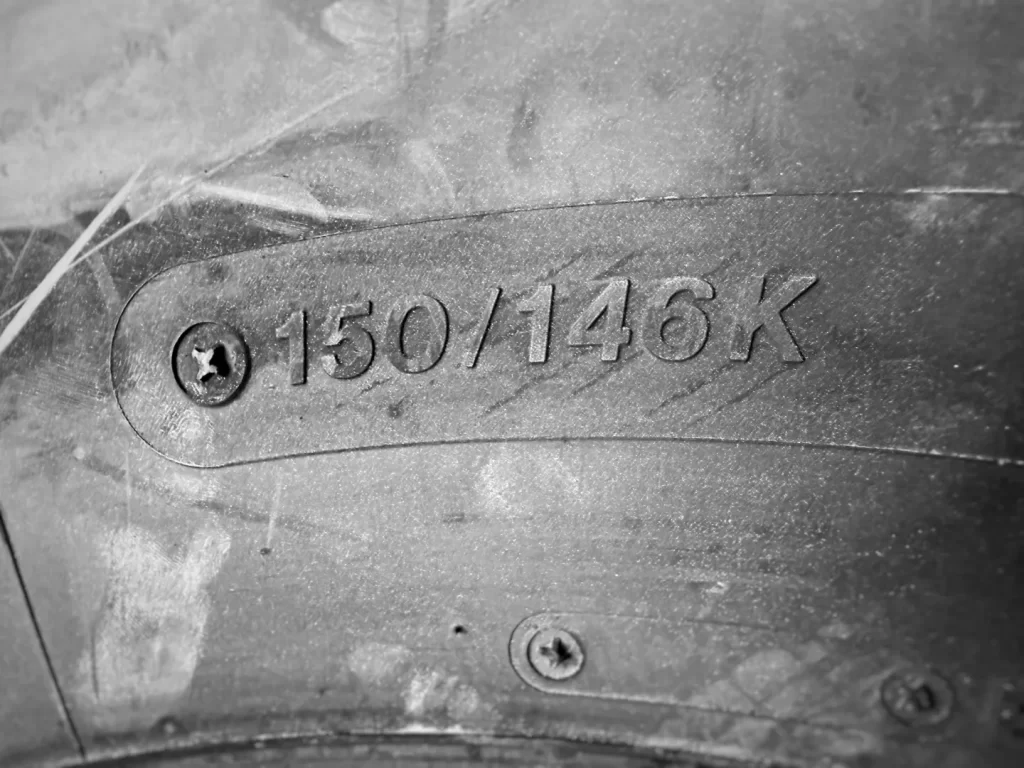
- 150 (Single Axle): Indicates that when this tire is mounted alone on an axle, it can safely support a maximum weight of 3,350 kg (7,390 lbs) at its rated cold inflation pressure.
- 146 (Dual Axle): When mounted side-by-side in a dual configuration, the certified rating drops to 146, meaning each tire is limited to 3,000 kg (6,610 lbs) to account for potential load imbalances caused by road crowning.
- K (Speed Symbol): Positioned right after the load indexes, the letter “K” restricts the vehicle’s safe mechanical speed to a maximum of 110 km/h (68 mph).
Seeing “150/146K” tells a fleet manager instantly that this tire is optimized for heavy hauling but must be restricted from high-speed express runs to avoid casing breakdown.
Case Study 2: The Advanced “Dual-Rating” Phenomenon (154/150 L vs. 152/149 M)
While standard tires offer a single operational limit, advanced commercial tires engineered for versatile fleet routes display a dual operating description, as shown in Figure 3. Here, the manufacturer provides two distinct choices based on speed vs. load dynamics:
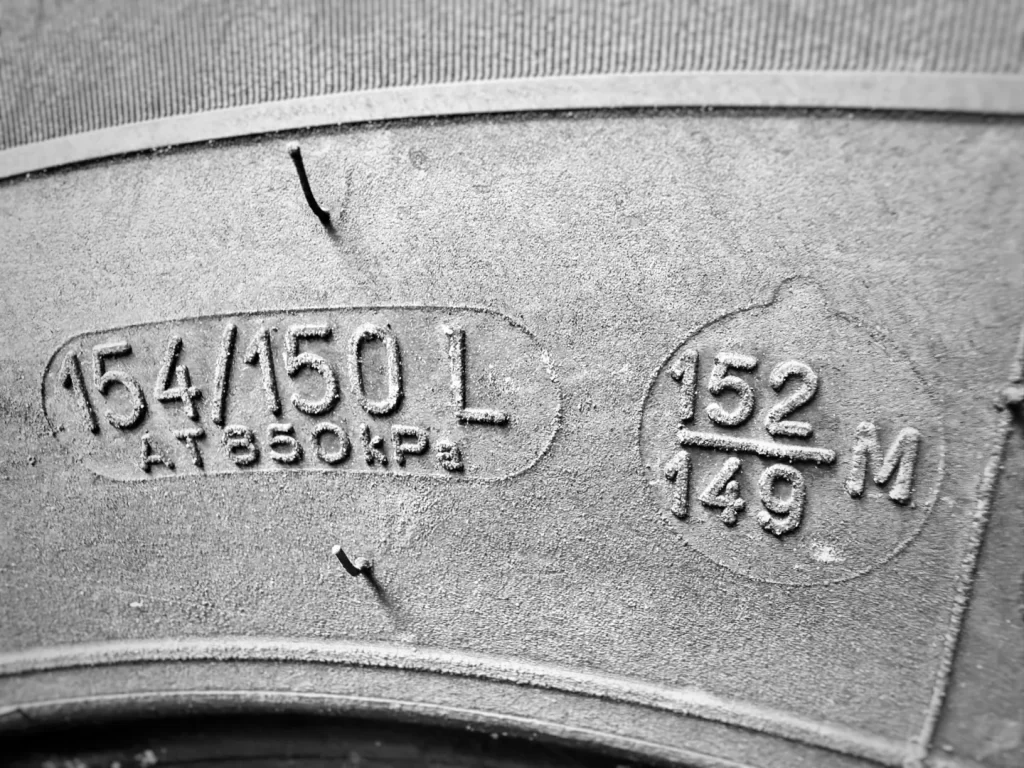
- The Speed Rating L Advantage (154/150 L): If your fleet restricts vehicle speed to a maximum of L (120 km/h), the tire rewards you with a higher structural capacity. It can safely carry up to 3,750 kg as a single tire or 3,350 kg per tire in a dual configuration. Lower speeds generate less heat, allowing the casing to handle extra weight safely.
- The Speed Rating M Trade-off (152/149 M): If the vehicle moves to high-speed expressways at a maximum of M (130 km/h), the safe load limit must automatically be scaled down to 3,550 kg (Single) and 3,250 kg (Dual). This reduction prevents the tire from generating destructive thermal energy under centrifugal force.
Understanding this dual-rating matrix allows logistics managers to adjust fleet loading protocols dynamically based on whether a truck is assigned to slow regional hauling or high-speed expressway transit, maximizing tire life and eliminating blowout risks entirely.
What You Won’t Find on a Truck Tire Sidewall
The Critical Link Between Tire Pressure and Load Capacity
A tire’s load index does not represent a static weight limit; rather, it defines the maximum capacity achievable only when the tire is inflated to its corresponding maximum cold inflation pressure. As shown in the chart for an 11R22.5 (Load Range G) tire, air pressure directly dictates structural capability. For instance, in a single axle setup at a maximum inflation of 105 psi (720 kPa), the tire can safely support its full rated load of 2,800 kg. However, if that same tire underinflates to 70 psi (480 kPa), its safe load limit plummets to 2,050 kg—a massive 26.7% drop in carrying capacity. Operating a heavily loaded fleet on underinflated tires forces the sidewall to over-flex, generating extreme heat that leads to rapid tread wear, casing fatigue, and catastrophic tire blowouts.
Tire Load Limits at Various Cold Inflation PressuresThe Pressure is Minimum for Load |
||||||||||
|---|---|---|---|---|---|---|---|---|---|---|
| MAXIMUM SPEED OF 65 (MPH) | Example for LRG | |||||||||
| SIZE | CONFIG | 70(480) | 75(520) | 80(550) | 85(590) | 90(620) | 95(660) | 100(690) | 105(720) | |
| 11R22.5 | Dual | kg | 1990 | 2080 | 2160 | 2250 | 2360 | 2460 | 2560 | 2650 (G) |
| lbs | 4380 | 4580 | 4760 | 4950 | 5205 | 5415 | 5625 | 5840 (G) | ||
| Single | kg | 2050 | 2160 | 2260 | 2370 | 2500 | 2600 | 2700 | 2800 (G) | |
| lbs | 4530 | 4770 | 4990 | 5220 | 5510 | 5730 | 5950 | 6175 (G) | ||
The Triad of Tire Performance: Pressure, Load, and Speed
For metric and wibe base tires
The service load and minimum (cold) inflation must comply with the following limitations unless a speed restriction is indicated on the tire or the manufacturer rates the tire at 75 mph or above.
| SPEED RANGE (MPH) |
RADIAL PLY TIRES | |
|---|---|---|
| INFL. PRESSURE CHANGE |
% LOAD CHANGE |
|
| 71 thru 75 | +5 psi | -12% |
| 66 thru 70 | +5 psi | -4% |
| 51 thru 65 | No Increase | None |
| 41 thru 50 | No Increase | +7% |
| 31 thru 40 | No Increase | +9% |
| 21 thru 30 | +10 psi | +12% |
| 11 thru 20 | +15 psi | +17% |
| 6 thru 10 | +20 psi | +25% |
| 2.6 thru 5 | +20 psi | +45% |
| Creep thru 2.5 | +20 psi | +55% |
| Creep (2) | +30 psi | +75% |
| Stationary | +30 psi | +105% |
Here is the condensed, professional English version of your notes, trimmed by 20% and featuring a final directive to consult a manufacturer expert:
Important Technical Notes for Fleets
- Standard Benchmark: The 51 to 65 mph range is the operating baseline. At this speed, the tire carries 100% of its rated load at the standard cold inflation pressure without adjustments.
- High-Speed Penalty: Operating above 65 mph (66 to 75 mph) requires adding +5 psi to combat sidewall deflection, while vehicle load capacity must be reduced by 4% to 12% to prevent severe overheating.
- Low-Speed Bonus: Dropping below 50 mph allows Metric & Wide Base tires to carry significantly higher loads (from +7% up to +105% when stationary). However, technicians must compensate by increasing cold inflation by +10 psi to +30 psi.
- Defining “Creep”: Creep speed applies to ultra-slow movements where the total travel distance does not exceed 200 feet (61 meters) within any 30-minute window.
- Rim Limitation Warning: Even if the tire can withstand a +105% load surge or a +30 psi pressure hike at low speeds, never exceed the maximum inflation or load limits of the rim/wheel. The wheel remains the absolute safety ceiling.
⚠️ Critical Action: Because multiplying load factors and boosting air pressures can drastically impact casing durability and vehicle dynamics, always consult your tire manufacturer’s technical engineering expert to validate your specific fleet application before implementing these low-speed or high-load adjustments.
Choosing the Right Tire for Your Fleet’s Vocation
While a tire’s sidewall lists technical specs like size and load index, it will never explicitly tell you if that rubber compound can survive your daily driving environment. To maximize tire life and prevent premature failures, every driver and fleet manager must understand their vehicle’s vocation—the specific application and terrain the truck tackles every day.
Buying a highway tire for a mud-filled job site, or putting heavy construction plies on a high-speed interstate haul, will destroy your fleet’s ROI. Here is how premium tire architectures are divided by vocation to match your vehicle’s exact operational needs:
| Icon | Application | Core Description | Key Technical Features |
|---|---|---|---|
| L | LONG HAUL | Our most fuel-efficient tires, designed for highway traffic over long distances with even wear. |
|
| R | REGIONAL | Flexible tires offering good fuel efficiency on the highway, with excellent durability for off-highway driving. |
|
| U | URBAN | Reinforced, durable tires that tackle the challenges of city traffic with ease. |
|
| C | CONSTRUCTION | Take on the tough terrain of job sites and varied road conditions with these durable, high traction tires. |
|
| O | OFF-ROAD | Our most durable, highest traction tires that perform their best in extreme locations. |
|
📌 Manufacturer Variation Note: Please note that the circular letters (L, R, U, C, O) and specific iconography shown above are standardized by certain premium manufacturers. Every tire brand utilizes its own unique naming conventions, lettering systems, or visual symbols on the sidewall to designate vehicle vocations. Always consult the specific manufacturer’s technical data book or your local authorized dealer to verify the exact application coding for the tire line you are running.
Commercial Truck Fleet Application and Vocation Matrix
To help you quickly cross-reference your specific fleet configuration with the proper tire engineering, reference the comprehensive application matrix below. This breakdown categorizes commercial transport operations into goods, people, and construction segments to ensure perfect vehicle-to-tire alignment:
| Group | Segment / Vocation | Recommended Icons |
|---|---|---|
| Goods | Car Carriers | L, R |
| General Freight (Long Haul) | L | |
| General Freight (Regional Haul) | R | |
| Local Pickup & Delivery Vehicles | R | |
| Lease & Rental Vehicles | L, R | |
| Refrigerated Trucks | L, R | |
| Beverage Haulers | R | |
| Household Movers | L, R | |
| Tankers / Liquid Bulk Haulers | R | |
| Hazardous Material Haulers | R | |
| People | Motor Coaches | L, R |
| School Buses | R, U | |
| City Buses | U, R | |
| RVs | L, R | |
| Construction | Construction Material Transport Vehicles | R, C |
| Utility Vehicles | R, C | |
| Emergency Vehicles | R, C | |
| Waste & Sanitation Vehicles | U, C | |
| Agriculture, Feed & Livestock Transport Vehicles | C | |
| Forestry & Lumber Vehicles | C | |
| Mining / Quarry Vehicles | O | |
| Heavy Haul & Special Load Transport Vehicles | C | |
| Cement Vehicles | C |
Once you know your vehicle’s segment and daily operating terrain, selecting the right tire is easy. Use the matrix below to quickly cross-reference your fleet setup (Goods, People, or Construction) for perfect vehicle-to-tire alignment.
💡 Quick Safety Tip: Tire tech evolves fast. The quickest, safest way to maximize your rubber’s ROI is to consult a tire manufacturer’s technical expert to validate your choice before buying.
FAQ:
The last four digits of the DOT code indicate the week and year the tire was manufactured. For example, a DOT code ending in 2526 means the tire was produced in the 25th week of 2026.
No. Modern truck tires do not contain the exact number of physical plies indicated by the Ply Rating. Instead, Load Range represents the tire’s equivalent strength and maximum inflation capability.
A REGROOVABLE marking means the tire has been designed with sufficient undertread rubber to allow new grooves to be safely cut into the tread after wear, extending service life and improving cost efficiency.
In most cases, using a tire with a higher Load Index is acceptable, provided it meets the vehicle manufacturer’s specifications and is compatible with the wheel, inflation pressure, and application requirements.
M+S (Mud and Snow) indicates that the tire’s tread pattern is designed to provide improved traction in mud and light snow. The 3PMSF (Three-Peak Mountain Snowflake) symbol certifies that the tire has passed standardized tests for severe winter conditions.
Nhat Diem Honq

