

Sai Gon, 24 Feb, 2026. Over the years of visiting fleets, one pattern has consistently emerged. Whenever services such as wheel alignment or balancing are raised, the response is immediate — and defensive.
“These dealers just want to charge more. They’re always pushing services we don’t need.”
The room laughs, and the conversation moves on. In many fleets, any service beyond tire replacement is met with suspicion.
Yet this assumption quietly drives cost. What is dismissed as unnecessary is often one of the few control points fleets actually have over tire wear and operating cost.
When problems appear, the conclusion is almost always the same: the tire is the problem.
Drivers report it. Fleet managers accept it.
The tire becomes the scapegoat. The problem is considered closed — not resolved.
The tires are replaced, the vehicle returns to the road, and the underlying issue remains.
What begins as a small maintenance decision becomes a cost that is no longer questioned — only absorbed.
It is no longer a maintenance issue. It is how the business chooses to operate.
Wheel Alignment in Fleet Maintenance: Why It Becomes a Market Problem
In practice, wheel alignment is rarely embedded in a structured maintenance plan. It is typically performed only after visible symptoms appear — uneven wear, steering pull, or driver complaints. Preventive alignment, conducted before issues surface, remains uncommon.
This pattern is shaped by several practical realities.
- First, preventive maintenance planning remains limited. Technical intervention often occurs only once symptoms are evident, by which point mechanical deviation has already progressed beyond minor correction. Wheel Alignment is therefore treated as a corrective action rather than a preventive control.
- Second, business priorities naturally center on revenue generation. Fleet owners focus on securing contracts and maximizing vehicle utilization. Gradual operational costs — such as tire wear — receive less strategic attention compared to immediate income.
- Third, wheel alignment is widely perceived as an additional expense instead of a cost-management tool. The service fee is immediate and visible, while the financial benefit develops gradually. Without consistent measurement, the connection between alignment and reduced cost per kilometer remains difficult to recognize.
As a result, alignment stays operationally optional — rather than strategically integrated.
The Consequence No One Talks About
When wheel alignment issues are ignored, irregular wear is often blamed on tire quality rather than mechanical deviation.
As a result, fleets conclude that premium tires deliver no real advantage. Decisions shift toward cheaper options — particularly Chinese brands supported by aggressive warranty policies from dealers, especially those importing tires directly.
Mechanical neglect quietly turns procurement into a price-driven game.
In many cases, the most dangerous competitor of a tire manufacturer is not another brand — but the very partner who has stood beside them for years.
How Wheel Alignment Becomes a Standard
Changing the Channel Is Not Enough
For dealers, the real issue is not equipment — it is mindset.
If profit is driven purely by tire volume, shorter tire life quietly becomes a business advantage. Cheap tires that wear faster mean quicker replacement cycles and higher turnover. In that model, wheel alignment is not a value-added service — it is a threat to sales volume.
A service-driven mindset changes that equation. Fewer tires sold does not mean lower profit. Revenue shifts from product turnover to performance management — alignment services, structured maintenance programs, and long-term fleet retention.
At that point, the question for manufacturers becomes unavoidable: reshape the dealer mindset — or reshape the dealer network.
Data Is the Real Trigger
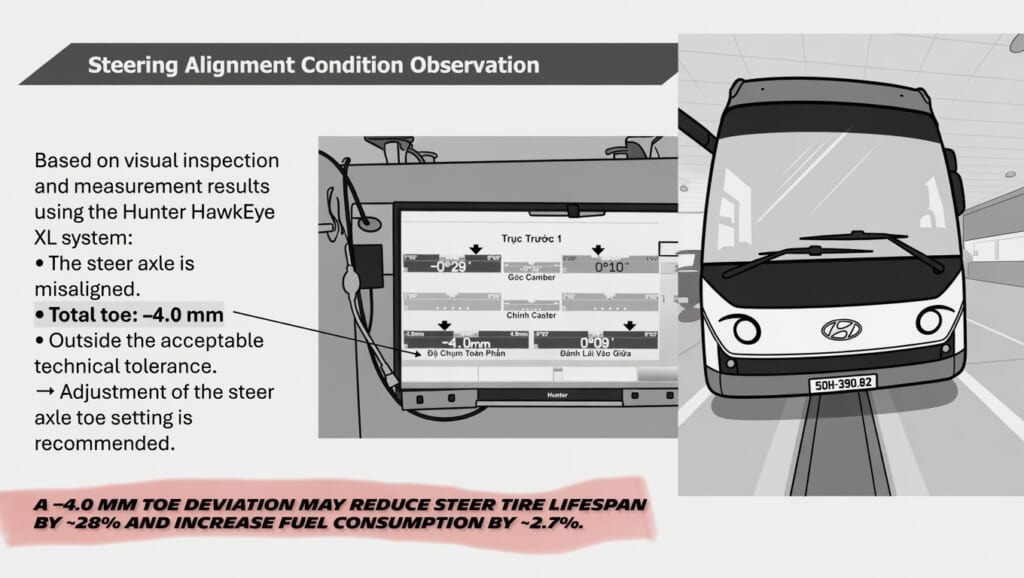
Fleets rarely change behavior on their own. If the tire manufacturer does not take the lead, alignment will remain a secondary service — never a core cost-control tool.
But persuasion alone does not move fleets. Evidence does.
Real mechanical measurements — axle deviation, improper angles, uneven load distribution — reveal what is actually happening on the vehicle. Not assumptions. Not opinions. Measured facts.
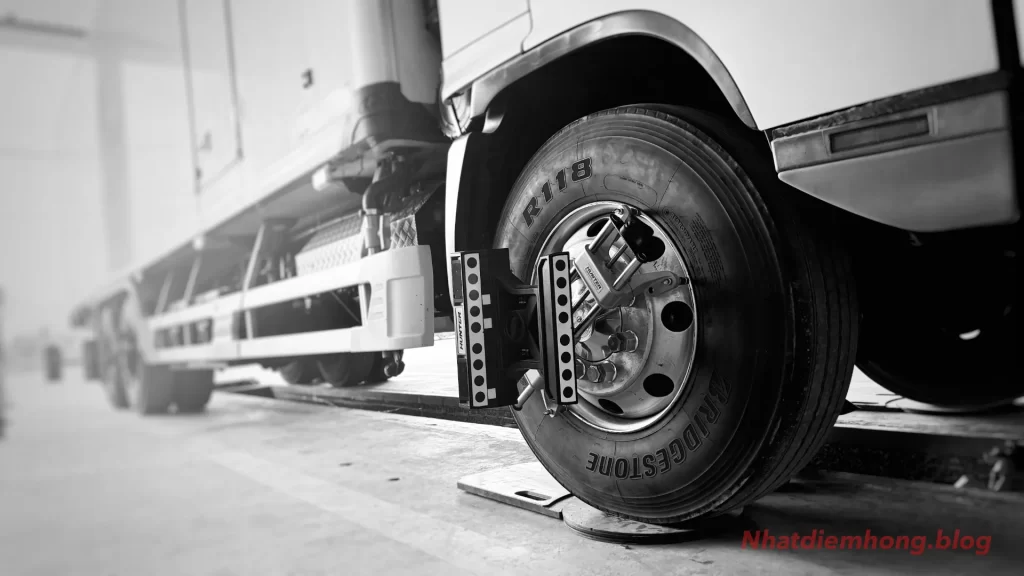
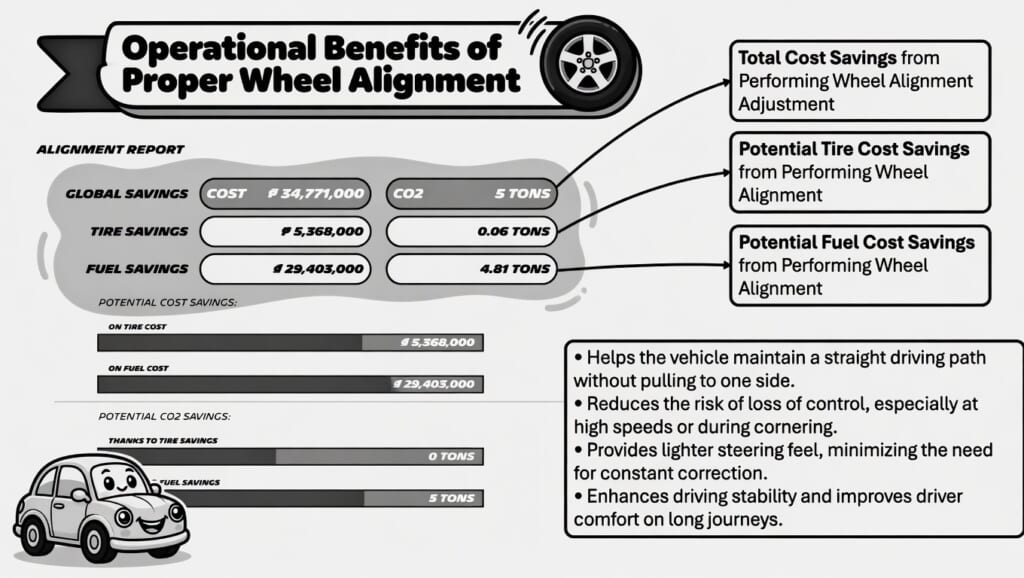
Yet technical data alone is not enough. What changes behavior is translation. When those deviations are converted into annual financial impact — lost tire life, additional fuel consumption, accumulated cost leakage — the conversation shifts.
Alignment stops being a technical recommendation. It becomes a financial decision.
And financial decisions are the ones fleets act on.
This is not a technical issue. It is a leadership test for the industry.
The fleets are not the obstacle.
The dealers are not the obstacle.
Even the technology is not the obstacle.
The real question is simple:
Who in this industry is willing to change the business model before the market forces it to change?
The future of tire business will not be decided by who sells more tires.
It will be decided by who controls cost per kilometer.
Alignment is simply where that shift begins.
Nhất Điểm Hồnq

