

Every Liter Has a Job
Every liter of diesel a fleet buys has only one job: move the truck forward.
Fleet operators don’t buy fuel simply to burn it. They buy fuel to deliver cargo, complete routes, and generate profit.
But not every liter of diesel becomes useful motion.
Some of its energy is inevitably lost before it reaches the road.
The question is simple:
Where does that energy go?
A Truck Is Always Fighting Resistance
Imagine a fully loaded truck cruising on a flat highway at a constant speed.
The truck isn’t accelerating.
It isn’t climbing a hill.
Yet the engine continues consuming fuel every second.
Why?
Because every moving truck must continuously overcome resistive forces.
Some are easy to see.
Air pushes against the front of the vehicle.
Gravity resists motion on uphill grades.
Others are almost invisible.
Mechanical friction occurs throughout the drivetrain.
And every tire resists motion where rubber meets the road.
Before any energy reaches the pavement, it follows a long path:
Diesel → Engine → Transmission → Drive Axle → Tire → Road → Vehicle Motion
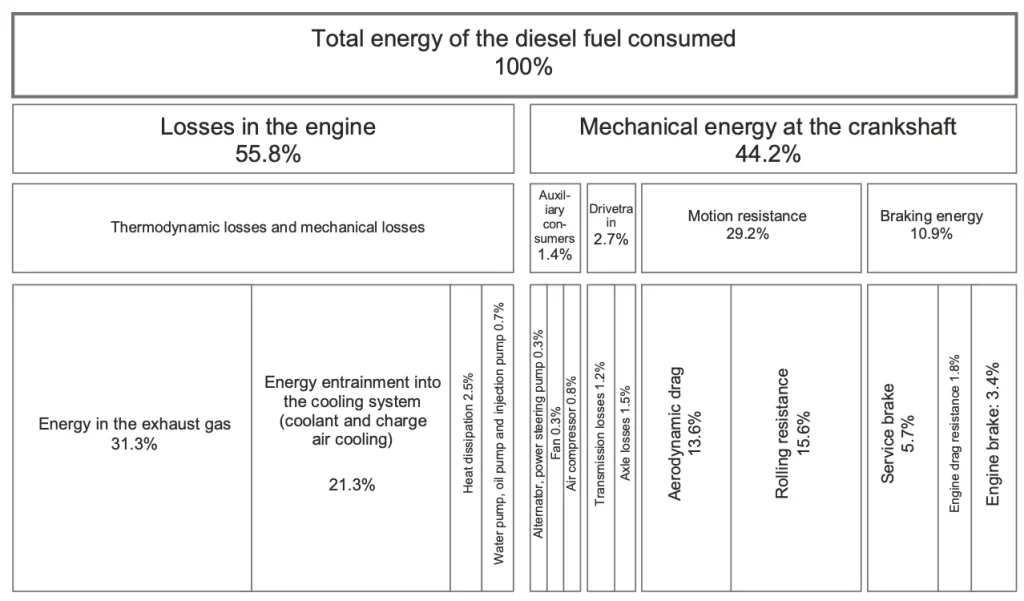
Every component along this path influences how much of the fuel’s energy ultimately becomes useful work.
The more energy lost anywhere in the system, the more fuel the engine must burn to keep the truck moving.
Not Every Resistance Behaves the Same
Not all resistive forces affect a truck equally.
Their contribution changes with vehicle speed and operating conditions.
At lower and moderate speeds, rolling resistance represents a significant share of the energy required to keep the vehicle moving.
As highway speed increases, aerodynamic drag rises rapidly and gradually becomes the dominant resistance.
This is why truck manufacturers invest heavily in aerodynamic design, while tire manufacturers focus on reducing rolling resistance.
Both pursue the same objective:
Help more of the diesel’s energy become useful motion instead of wasted energy.
Why Tires Need Energy to Roll
Most people imagine a tire simply rolling along the road.
In reality, it is constantly changing shape.
As the tire enters the contact patch, it compresses under the vehicle’s weight.
As it leaves the pavement, it returns to its original shape.
This deformation happens thousands of times every kilometer.
Rubber is highly elastic, but not perfectly elastic.
Each deformation cycle consumes a small amount of energy that is converted into heat instead of helping move the truck.
Engineers call this continuous energy loss rolling resistance.
Small Losses Become Big Costs
The energy lost during a single tire rotation is tiny.
On its own, it is almost impossible to measure.
However, a commercial truck doesn’t operate for one revolution.
It travels hundreds of thousands of kilometers over its service life.
That means millions of tire revolutions.
A tiny amount of wasted energy, repeated millions of times, gradually becomes measurable fuel consumption.
What begins as a physics phenomenon eventually appears on a fleet’s fuel bill.
Rolling resistance is therefore more than an engineering concept.
It is an operating cost.
Why Rolling Resistance Can’t Be Eliminated
At first glance, the solution seems obvious.
If rolling resistance consumes fuel, why not eliminate it completely?
Because rolling resistance isn’t a design flaw.
It is the natural result of using pneumatic tires to support heavy loads while providing traction, ride comfort, durability, and braking performance.
Every truck tire must deform.
Without deformation, it couldn’t carry the vehicle safely or maintain grip on the road.
The engineering challenge isn’t eliminating rolling resistance.
It’s reducing unnecessary energy loss while preserving every other performance characteristic fleets depend on.
Why Fleets Invest in Low Rolling Resistance Tires
For most commercial fleets, fuel is one of the largest controllable operating expenses.
A one-percent improvement in fuel economy may appear insignificant for a single trip.
Over hundreds of thousands of kilometers and an entire fleet of vehicles, however, that small improvement can translate into substantial savings.
Fleet managers therefore evaluate tires differently from individual drivers.
The question is rarely:
“Which tire has the lowest rolling resistance?”
Instead, the question is:
“Which tire reduces the overall cost of moving freight?”
Low Rolling Resistance (LRR) tires create value because they improve one part of that equation.
How Low Rolling Resistance Tires Reduce Energy Loss
A Low Rolling Resistance tire doesn’t create more energy.
It simply allows more of the available energy to reach the road.
Manufacturers achieve this by optimizing the tire as a complete system rather than relying on a single design feature.
The rubber compound reduces internal heat generation.
The tread pattern minimizes unnecessary movement while maintaining traction.
The casing is engineered to deform more efficiently under load.
Individually, these improvements may appear small.
Together, they reduce the energy lost during millions of tire revolutions throughout the tire’s service life.
The result is lower fuel consumption without sacrificing the durability, safety, and reliability required in commercial vehicle applications.
By reducing unnecessary energy loss inside the tire, they help lower fuel consumption without requiring changes to the engine, transmission, or driving operation.
In other words, LRR tires don’t simply improve a tire specification.
They improve how efficiently the entire vehicle converts diesel into productive motion.
Case Study – When Tiny Energy Losses Become Real Money
Physics explains why rolling resistance exists.
Fleet economics explains why it matters.
Consider a simple example.
Example Fleet
- 100 long-haul tractors
- 120,000 km traveled per truck per year
- Average fuel economy: 35 L/100 km
- Annual diesel consumption:
- 42,000 liters per truck
- 4.2 million liters for the fleet
Now assume Low Rolling Resistance tires improve overall fuel economy by 2% under these operating conditions.
Annual fuel savings become:
- 840 liters per truck
- 84,000 liters across the fleet every year
If diesel costs US$1.20 per liter, the fleet saves approximately:
US$100,800 annually
And that’s before considering lower CO₂ emissions or the cumulative savings over several years.
The exact numbers will vary depending on vehicle specification, route profile, payload, driving style, tire maintenance, and fuel prices.
But the underlying principle never changes.
Small reductions in energy loss become meaningful financial savings when multiplied across millions of kilometers and hundreds of vehicles.
When Does Low Rolling Resistance Make Sense?
Reducing rolling resistance is beneficial, but it is not always the primary objective.
The value of a Low Rolling Resistance tire depends on how the vehicle is operated.
Long-Haul Fleets
Long-haul trucks spend most of their time cruising at relatively stable speeds over long distances.
Because fuel represents a major operating expense, even modest improvements in fuel efficiency can generate significant savings over hundreds of thousands of kilometers.
For these fleets, Low Rolling Resistance tires often provide the strongest return on investment.
Regional Distribution
Regional trucks operate under mixed conditions, combining highway driving with frequent stops.
Rolling resistance remains important, although the benefits may vary depending on average speed, payload, and route profile.
A balanced tire offering both fuel efficiency and long tread life is often the preferred choice.
Urban Delivery
Urban vehicles accelerate and brake repeatedly throughout the day.
Fuel consumption is influenced not only by rolling resistance, but also by acceleration losses, traffic conditions, and idle time.
LRR tires can still contribute to fuel savings, but they are only one part of a much larger efficiency strategy.
Construction and Off-Road Applications
Construction trucks often operate on rough surfaces where traction, cut resistance, and durability take priority over fuel economy.
In these applications, selecting the tire with the lowest rolling resistance may not deliver the lowest total operating cost.
Choosing the right tire always depends on the job it is expected to perform.
Questions Fleet Managers Should Ask Before Choosing an LRR Tire
Rather than asking,
“Is this a Low Rolling Resistance tire?”
fleet managers often achieve better results by asking a different question:
“Will this tire reduce my fleet’s Total Cost of Ownership?”
The answer depends on the operating environment.
Consider the following questions before making a tire selection:
- What is the truck’s average operating speed?
- Does the fleet spend most of its time on highways or in stop-and-go traffic?
- Which costs have the greatest impact on the business—fuel, tire replacement, maintenance, or downtime?
- How important is tread life compared with fuel efficiency?
- Will the tire be retreaded one or more times?
- Is inflation pressure consistently maintained across the fleet?
- Does the expected fuel saving justify the purchase price?
A long-haul fleet, a regional carrier, and a construction contractor may all choose different tires—and all make the correct decision.
The objective isn’t to achieve the lowest rolling resistance.
The objective is to achieve the lowest Total Cost of Ownership for the specific operation.
Final Thoughts
Every liter of diesel begins its journey as stored chemical energy.
Only a portion of that energy eventually becomes useful motion.
Along the way, some is lost to aerodynamic drag.
Some is consumed by mechanical friction.
Some is converted into heat as truck tires continuously deform against the road.
These losses are individually small.
Almost invisible.
Yet they occur millions of times throughout the life of every commercial vehicle.
That is why rolling resistance is more than a tire specification.
It is an energy management challenge.
For tire engineers, the challenge is reducing unnecessary energy loss without compromising safety, durability, or performance.
For fleet managers, the challenge is selecting the tire that delivers the lowest Total Cost of Ownership—not simply the lowest rolling resistance.
Understanding where energy is lost is the first step.
Turning that understanding into better fleet decisions is where the real value begins.
That is how diesel is transformed into profit.
Nhat Diem Honq

