

In Vietnam’s road transport decarbonization journey, tire inflation pressure remains one of the most influential yet under-managed technical parameters. From a tire manufacturer’s perspective, pressure management is not merely a driving habit, but a fundamental lever that directly impacts safety, casing durability, total cost of ownership, and the environmental footprint of fleet operations.
Legacy practices and the transition from bias to radial tires
The widespread practice of inflating truck tires at relatively high pressure levels among experienced drivers can be traced back to the era when bias-ply tires were dominant. Their stiffer carcass construction allowed greater tolerance to overinflation. However, as the transport industry progressively adopted radial tire technology—characterized by steel-belted radial carcasses designed to operate within defined pressure ranges based on axle load and duty cycle—this technological evolution was not consistently accompanied by structured technical communication and training.
As a result, informal pressure “rules of thumb,” such as inflating 11.00R20 tires to 11.0 bar or 12R22.5 tires to 12.0 bar, continue to be widely applied, despite the fact that radial tire performance and durability depend on maintaining inflation pressure aligned with actual operating loads rather than nominal tire size.
Operational consequences of improper inflation pressure
In fleet environments where fuel consumption is often managed through driver-based incentives, but tire pressure is not systematically monitored, some drivers intentionally overinflate tires in pursuit of short-term rolling resistance reduction. While this approach may deliver marginal fuel benefits, sustained overinflation of radial tires generates unfavorable stress concentrations within the casing structure, particularly in the steel belt package and sidewall flex zones.
Over time, this accelerates casing fatigue, leads to irregular wear patterns, and results in premature tire removal—even when remaining tread depth would otherwise allow continued service. At the same time, excessive inflation reduces the tire’s contact patch, negatively affecting braking grip and vehicle stability, particularly under emergency or low-adhesion conditions.
Conversely, insufficient monitoring of dual inner tires often leads to prolonged underinflation. This condition significantly increases heat generation, raising the risk of casing damage or sudden failure, while also contributing to higher operating costs and unplanned vehicle downtime.
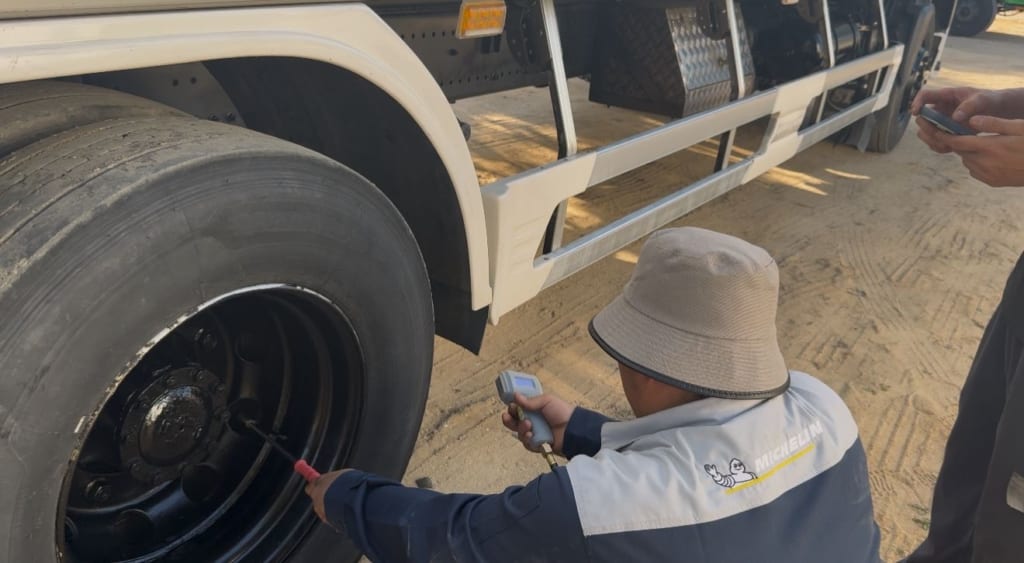
Lifecycle and ESG implications
From a lifecycle perspective, premature tire removal has a direct environmental impact. When tire service life is reduced by approximately 15–20%, the carbon emissions associated with tire manufacturing—largely fixed at the production stage—are amortized over fewer kilometers. For vehicles operating with 10 to 22 tires, this effect can translate into an additional 0.7–1.0 tons of CO₂e per vehicle per year attributable solely to suboptimal inflation pressure management.
At fleet scale, with an estimated 1.2–1.4 million medium- and heavy-duty trucks currently in operation in Vietnam, aligning tire inflation pressure with actual operating conditions and extending tire service life by around 20% represents a tangible opportunity to reduce annual carbon emissions by several hundred thousand tons of CO₂e. This reduction is achieved not through new materials or alternative powertrains, but by maximizing the utilization of existing tire resources and preserving casing integrity for extended service or retreading.
From driver practice to fleet management discipline
Sustainable improvement in tire pressure management requires a shift from individual driving habits to structured fleet-level governance. Inflation pressure should be treated as a technical management parameter, integrated into maintenance routines and performance monitoring, rather than left to subjective judgment.
In this context, tire manufacturers and technology providers play a critical role by supplying clear load–pressure recommendations, technical training, pressure monitoring solutions, and data-driven tire management tools. These measures enable fleets to transition from experience-based practices to consistent, measurable, and repeatable tire management processes.
When tire pressure is correctly managed, safety performance, tire durability, operating efficiency, and environmental outcomes naturally converge. Pressure management thus becomes a practical ESG lever—one that allows transport operators to improve operational resilience while reducing their environmental footprint through disciplined use of existing assets.
Ultimately, regaining control over tire management—starting with inflation pressure—allows transport enterprises to protect casing value, improve fleet reliability, and contribute meaningfully to long-term emissions reduction without compromising operational performance.

