

Saigon, 5 Jul, 2026. Drive tires don’t decide how they wear.
The engine does.
The axle does.
The suspension does.
Tire pressure does.
The load does.
The driver does.
By the time abnormal wear appears on the tread, the real cause has often been shaping that pattern for thousands of kilometers.
That’s why experienced fleet engineers rarely begin by asking,
“What’s wrong with the tire?”
Instead, they ask,
“What is this tire trying to tell us about the truck?”
Because drive tire wear is rarely just a tire problem.
It is one of the clearest records of how energy has moved through the entire vehicle.
Every Wear Pattern Begins With Energy
Every abnormal wear pattern begins long before the tread starts to disappear.
It begins with energy.
Every time a truck pulls away, climbs a hill, or accelerates onto a highway, the engine generates torque. That torque travels through the transmission, driveshaft, differential, and axle before finally reaching the drive tires.
Only then can the truck move forward.
The drive tire is the final link in this chain—the point where engine torque meets the road.
With every rotation, the tread blocks deform, grip the pavement, transmit driving force, and recover as they leave the contact patch. This cycle repeats thousands of times every kilometer.
Under ideal conditions, these forces are evenly distributed, producing slow, uniform wear.
But trucks rarely operate under ideal conditions.
Low inflation enlarges the contact patch. Overloading increases tread stress. Misalignment introduces lateral scrub. Aggressive acceleration applies excessive torque. Worn suspension changes how the tire meets the road.
None of these problems start in the tire.
Yet every one of them changes how energy flows through it.
Over thousands of kilometers, those invisible changes become visible. What appears to be random tread wear is actually a physical record of the forces the tire has experienced throughout its life.
The tread doesn’t record what happened to the tire. It records what happened to the truck.
Before we identify different wear patterns, we need to understand one fundamental principle:
A tire never creates force. It only responds to force.
A drive tire cannot tell you what it has been through. It can only show you. Every groove, every worn shoulder, every irregular tread block is part of the story written by the forces it has endured.
How to Read a Wear Pattern
Before looking at individual wear patterns, remember one important principle: a wear pattern is not a diagnosis.
The same pattern can have different root causes depending on where the tire is mounted, how the vehicle operates, and the forces acting on it. A drive tire, steer tire, and trailer tire may all exhibit similar-looking wear, yet the physics behind it can be completely different.
That’s why each wear pattern should be interpreted within the context of tire position, vehicle dynamics, and fleet operation—not in isolation.
Center Wear
What It Looks Like
Center wear occurs when the center ribs wear noticeably faster than the shoulders. As the tread wears, the middle of the tire becomes flatter while the shoulders retain greater tread depth.
The pattern is usually consistent around the circumference of the tire rather than appearing in isolated sections.
Common Causes
Center wear is most commonly associated with inflation pressure that is higher than required for the actual axle load.
Higher inflation reduces the size of the contact patch, concentrating more contact pressure on the center ribs. On drive tires, these center ribs must also transmit engine torque to the road. The combination of higher contact stress and continuous traction gradually removes more rubber from the center than from the shoulders.
Although overinflation is the primary contributor, it should not be viewed in isolation. Tire pressure, axle load, vehicle application, and operating conditions always work together to determine how the contact patch carries the load.
Field Observation
Center wear on drive tires is often linked to overinflation, but in many fleets, the real issue is the relationship between inflation pressure and actual operating load.
A common example is one-way freight. Tires are inflated for a fully loaded outbound trip, but the truck returns with little or no cargo while tire pressure remains unchanged. With less load acting on the tire, the contact patch becomes smaller, increasing pressure on the center ribs and gradually accelerating center wear.
This operating condition is one reason why some trucks are equipped with lift axles. When running empty or lightly loaded, raising the lift axle transfers more weight onto the remaining tires, helping them operate closer to their designed load and maintaining a healthier contact patch.
Center wear, therefore, is not simply a sign of excessive inflation. It often indicates that inflation pressure and operating load are no longer matched.
What to Check
– Verify cold inflation pressure against actual axle loads rather than the tire sidewall rating alone.
– Review vehicle loading patterns, especially whether trailers frequently operate empty.
– Compare wear across all tire positions before concluding that overinflation is the sole cause.
– Confirm that inflation practices match the vehicle’s actual operating conditions.
Looking Beyond Tire Pressure
Center wear illustrates an important reality: the correct tire pressure depends on the load being carried.
A truck may leave fully loaded and return empty, yet its tire pressure remains unchanged. This changing relationship between load and inflation is one reason why Central Tire Inflation Systems (CTIS) and Automatic Tire Inflation Systems (ATIS) are gaining attention. Their goal isn’t simply to maintain pressure—it’s to maintain the right pressure for the operating condition.
Heel-and-Toe Wear
What It Looks Like
Heel-and-toe wear develops when each tread block wears unevenly from front to back. One edge of the block remains relatively sharp, while the opposite edge becomes rounded or worn away, creating a saw-tooth profile around the circumference of the tire.
The pattern is usually consistent across multiple tread rows and is most noticeable when running a hand across the tread in opposite directions.
Common Causes
Heel-and-toe wear is often mistaken for a drive axle wear pattern. In reality, it is a tread block wear pattern.
It doesn’t develop simply because a tire is mounted on the drive axle. It develops because the tire is built with independent tread blocks that continuously deform as they enter and leave the contact patch.
Unlike rib-pattern tires, each tread block compresses as it contacts the road, transmits driving force, and then recovers as it leaves the pavement. Although the movement is almost imperceptible, the leading and trailing edges of every tread block experience slightly different forces during each rolling cycle.
A calligraphy brush offers a useful comparison. As the brush touches the paper, its bristles flex under pressure before lifting away, leaving a distinctive stroke. A tread block behaves in much the same way. Every contact with the road leaves a tiny difference in wear between its leading and trailing edges.
Over millions of rolling cycles, those tiny differences gradually build into the characteristic heel-and-toe pattern.
Because this mechanism is created by the tread block design, heel-and-toe wear can also develop when a drive-pattern tire is fitted to a trailer axle. The axle position affects how quickly the pattern develops, but the tread design makes it possible.
Field Observation
Heel-and-toe wear is most commonly observed on drive-pattern tires because they use independent tread blocks to maximize traction. However, the same wear pattern can also appear when this type of tire is fitted to trailer axles.
This is why heel-and-toe should not be interpreted simply as a “drive axle wear pattern.” It is better understood as a wear pattern associated with block-type tread designs.
In most commercial fleets, a moderate amount of heel-and-toe wear is considered normal. The real concern is not whether the pattern exists, but how quickly it develops and whether it begins to affect vibration, noise, or tread life.
What to Check
– Tire rotation interval.
– Inflation pressure consistency across the drive axle.
– Suspension and shock absorber condition.
– Excessive wheel-end movement or bushing wear.
– Vehicle duty cycle, especially frequent acceleration and engine braking.
– Tread depth differences between dual tires.
Maintenance Tip
Many modern drive tires use directional tread patterns to balance traction and rolling resistance. Always install them in the correct rolling direction to achieve the fuel efficiency and wear performance they were designed for.
At around 50% tread wear, many fleets also turn the tire on the rim to slow heel-and-toe wear and recover additional usable tread.
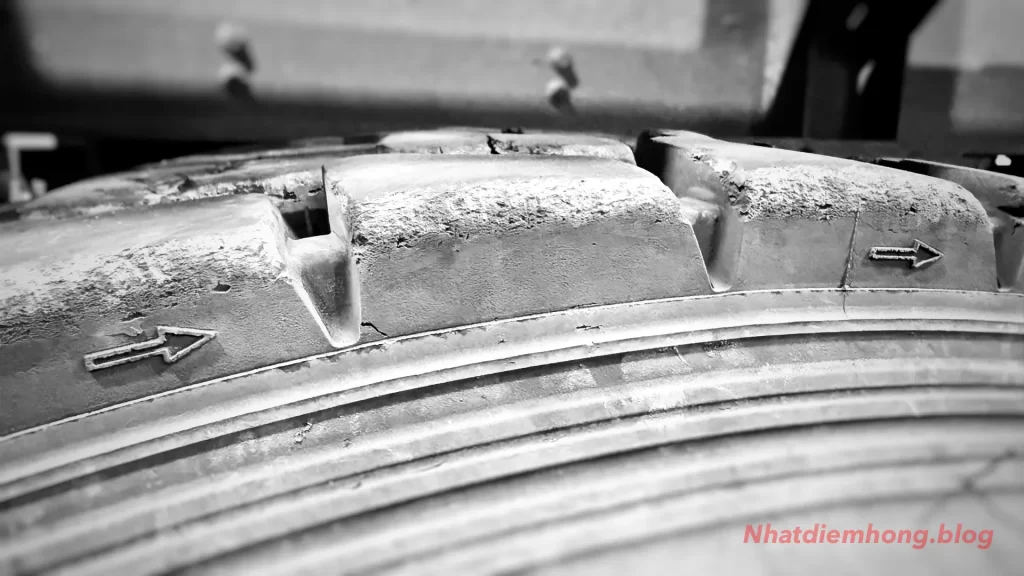
Small maintenance decisions often deliver savings that aren’t immediately visible—but become significant over the tire’s service life.
One-Sided Shoulder Wear
What It Looks Like
One-sided shoulder wear occurs when one shoulder of the tire wears significantly faster than the other.
On dual drive tires, the pattern often appears as a pair: the outside tire wears on its outer shoulder, while the inside tire wears on its inner shoulder. Unlike heel-and-toe wear, the tread blocks remain relatively uniform. Instead, the entire shoulder gradually loses rubber, indicating that the tire has been subjected to a consistent lateral load over a long period.
Common Causes
One-sided shoulder wear is rarely created by the tire itself. More often, it reflects how the axle carries and distributes load.
Ideally, both tires in a dual assembly should share the vehicle’s weight evenly while rolling in the same direction. When suspension geometry changes under load or the axle no longer remains perfectly aligned, the tires begin to scrub sideways instead of rolling freely.
The lateral movement is almost invisible during a single wheel rotation, yet over hundreds of thousands of kilometers it gradually removes rubber from one shoulder faster than the other.
Unlike center wear, which reflects contact pressure, or heel-and-toe wear, which reflects tread block deformation, one-sided shoulder wear primarily reflects changes in axle geometry and load distribution.
Field Observation
One-sided shoulder wear is frequently found on heavily loaded commercial vehicles, where suspension components operate close to or beyond their intended design range.
As springs, equalizers, bushings, or other suspension components deflect under sustained loads, the axle geometry changes slightly. Although these changes are measured in millimeters rather than centimeters, they are repeated millions of times throughout the tire’s service life, gradually creating a consistent shoulder wear pattern.
Battery-electric buses provide another interesting example. The additional mass of the battery system and its location within the chassis can change how load is distributed across the drive axle. On some vehicle designs, one side of the axle consistently carries more load than the other, causing the tires on that side to wear faster despite correct inflation pressure and regular maintenance.
The wear pattern, therefore, often reflects how the vehicle is engineered and loaded, not simply how the tire is maintained.
What to Check
– Inspect axle alignment and thrust angle.
– Check suspension components, including springs, equalizers, bushings, torque rods, and U-bolts.
– Compare both tires in the dual assembly rather than inspecting a single tire in isolation.
– Review the vehicle’s loading history and operating conditions.
– For battery-electric vehicles, consider whether vehicle architecture and weight distribution may be contributing to uneven shoulder wear.
Looking Beyond Alignment
One-sided shoulder wear doesn’t stop once it appears. Even after the root cause is corrected, the tire will continue wearing unevenly unless it’s managed.
Monthly tread inspections allow fleets to intervene before one-sided wear becomes irreversible. Performing a turn-on-rim at around 2 mm of shoulder difference can recover up to 25% more usable tread than waiting until the difference reaches 3–4 mm.
Road-Induced Damage
What It Looks Like
Unlike wear patterns that develop gradually over thousands of kilometers, external damage usually appears suddenly. The tread may show cuts, chipped tread blocks, embedded stones, or localized flat spots caused by severe braking.
These conditions are often confined to specific areas of the tire rather than developing uniformly around the circumference.
Common Causes
External damage is primarily caused by the operating environment rather than the tire itself.
Sharp rocks can become trapped in tread grooves, gradually drilling deeper into the casing. Rough quarry or construction roads may chip away tread blocks faster than normal wear. Emergency braking can generate enough friction to lock the tire against the pavement, creating localized flat spots and excessive heat.
Unlike center wear or heel-and-toe wear, these conditions are not driven by tire design, inflation pressure, or suspension geometry. They are the result of road conditions and unexpected operating events.
Field Observation
External damage often reflects where a vehicle operates rather than how it is maintained.
A highway tractor and a construction truck may use the same tire, yet experience completely different tread conditions simply because they operate on different surfaces. Likewise, an occasional emergency braking event may leave visible marks on an otherwise well-maintained tire.
Not every damaged tire indicates poor maintenance. Sometimes, the operating environment simply exceeds what the tire was designed to withstand.
What to Check
– Remove stones trapped in the tread before they penetrate deeper into the casing.
– Inspect cuts and chips regularly to determine whether they are cosmetic or have reached the steel belts.
– Investigate flat spots after severe braking and check for internal tire damage if vibration develops.
– Match tire design to the vehicle’s operating environment, especially for off-road or mixed-service applications.
Looking Beyond Damage
A tire cannot choose the road it runs on.
Selecting the right tread design, maintaining safe driving habits, and matching the tire to the application are often more effective than trying to repair damage after it occurs.
Dual Tire Matching: Keeping Energy in Balance
Every wear pattern we’ve explored so far has its own immediate cause. Center wear reflects the relationship between inflation pressure and load. Heel-and-toe wear develops from tread block deformation. One-sided shoulder wear reveals changes in suspension geometry.
Yet behind many of these wear patterns lies a common engineering principle:
Energy must be shared evenly.
A dual tire assembly is designed to behave as a single mechanical system. Both tires are expected to carry the load, transmit engine torque, absorb road impacts, and roll together as one. When they do, energy flows evenly through the axle, and both tires age at nearly the same rate.
The problem begins when that balance is lost.
One Axle. Two Tires. One System.
Dual matching is often explained in terms of tire diameter or inflation pressure. Those are important, but they are only symptoms of a larger principle.
Whenever two tires differ in inflation pressure, tread depth, rolling radius, or construction, they no longer share the same amount of work.
One tire carries more load.
One tire deflects more.
One tire transmits more torque.
One tire generates more heat.
The tire isn’t failing because it is weaker. It is simply absorbing more energy than its partner.
Like two people carrying the same box, if one person takes more of the weight, fatigue appears much sooner.
When Two Tires Stop Sharing the Work
Once energy is no longer distributed evenly, the consequences spread throughout the entire vehicle system.
Unequal load changes the contact patch.
Unequal rolling radius creates microscopic slip.
Unequal deflection increases heat generation.
Unequal traction accelerates tread wear.
What begins as a small mismatch gradually develops into faster wear, shorter casing life, and more frequent tire replacement.
Dual mismatch doesn’t create a new wear pattern.
It accelerates the wear patterns that already exist.
Why It Matters to Fleet Performance
For a single truck, the effect may seem insignificant.
For an entire fleet, it becomes measurable.
Shorter tire life increases replacement frequency.
Higher rolling resistance increases fuel consumption.
Additional heat reduces casing durability and retread potential.
More tire changes increase maintenance downtime.
What starts as a few millimeters of mismatch can eventually influence the fleet’s cost per kilometer, tire budget, and vehicle availability.
This is why experienced fleet engineers don’t see two tires mounted on the same axle.
They see one energy management system.
Maintenance Best Practice
Proper dual matching is not a one-time installation task. It requires continuous monitoring throughout the tire’s service life.
Many fleets include dual tire matching as part of scheduled tire inspections, typically every 60,000 km or whenever tires are rotated or replaced. Measuring the outside diameter and pairing tires with similar rolling circumference helps ensure both tires share the load evenly.
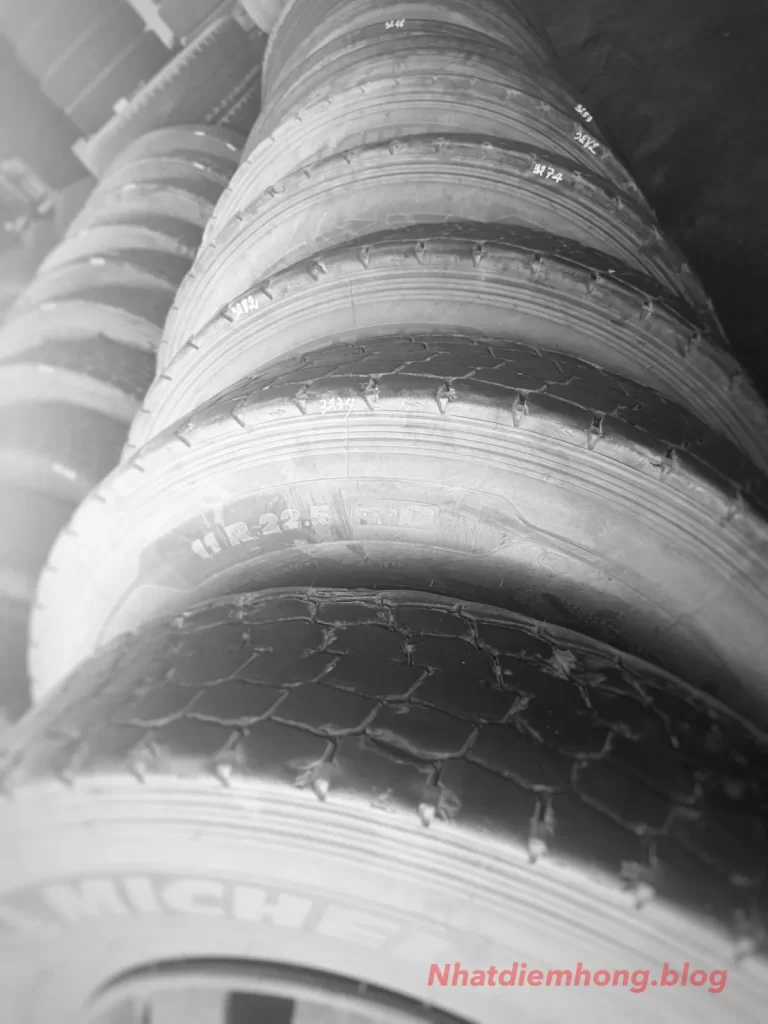
Maintaining consistent inflation pressure is equally important. Even a well-matched dual assembly will lose its balance if one tire operates at a different pressure. Regular pressure inspections—or preferably a Tire Pressure Monitoring System (TPMS)—help maintain uniform load sharing and detect problems before uneven wear begins.
In the end, dual matching is not simply about pairing two tires. It is about keeping two tires working as one throughout their entire service life.
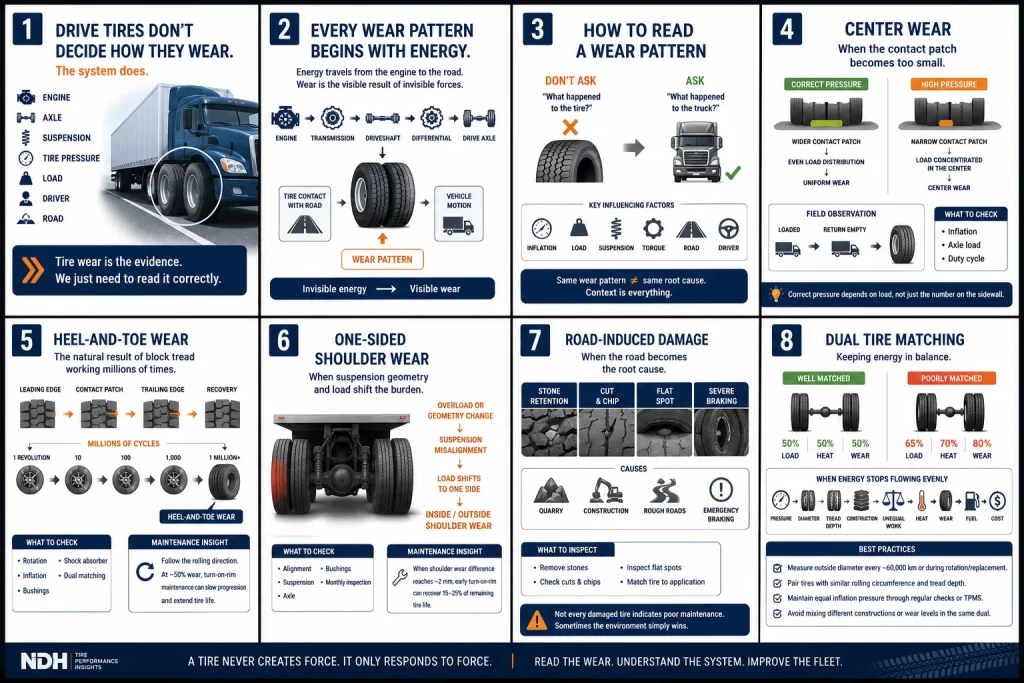
Every drive tire wear pattern tells the story of how energy moves through a commercial vehicle.
The Tire Was Never the Problem
Tires are often treated as consumable products.
In reality, they are one of the few components that continuously record how a commercial vehicle performs.
Every wear pattern is evidence of how energy moved through the truck—how load was shared, how torque reached the road, and how the vehicle was maintained and operated.
Read correctly, a tire becomes more than a tire. It becomes a diagnostic tool for the entire commercial vehicle system.
And once you understand what the tire is telling you, maintenance is no longer about replacing rubber.
It’s about improving vehicle performance, reducing fleet operating costs, and making better engineering decisions.
Because the tire was never the problem. It was simply where the vehicle left its evidence.
Read correctly, a tire becomes more than a tire. It becomes a diagnostic tool for the entire commercial vehicle system.
FAQ
Drive tires perform a fundamentally different job from steer tires. Instead of simply guiding the vehicle, they must transmit engine torque to the road. Every acceleration, hill climb, and engine braking event passes through the drive axle before reaching the tread. As a result, drive tires experience higher longitudinal forces, greater tread block deformation, and more heat, all of which contribute to faster wear.
Not necessarily.
Center wear usually indicates that inflation pressure is too high for the actual load being carried, rather than simply being “too much air.” This commonly occurs in commercial fleets when trucks return empty after being inflated for fully loaded outbound trips. The relationship between tire pressure and axle load is often more important than tire pressure alone.
No.
Heel-and-toe wear is a natural characteristic of block-pattern drive tires. As each tread block enters and leaves the contact patch, the leading and trailing edges experience slightly different forces. Over millions of rolling cycles, these small differences gradually create the saw-tooth pattern. The concern is not whether heel-and-toe appears, but how quickly it develops.
Many commercial fleets inspect and rematch dual tires approximately every 60,000 km, or whenever tires are rotated, replaced, or repaired. Matching tires with similar outside diameter, tread depth, and inflation pressure helps ensure both tires share load evenly and reduces uneven wear.
Yes.
Many abnormal wear patterns originate outside the tire itself. Uneven wear can indicate incorrect inflation, excessive axle loading, suspension wear, alignment issues, or poor dual tire matching. When interpreted correctly, the tread becomes a valuable diagnostic tool for understanding how the entire commercial vehicle system is performing.
Nhat Diem Honq

