

Sai Gon, 29 Mar, 2026
Why is price always the first thing truck drivers look at?
Because it is visible, simple, and easy to compare.
In a market full of uncertainty, price becomes the fastest and most accessible signal — allowing fleets to make quick decisions across multiple dealers. But what is easy to compare is not always what drives real cost.
This is why cheap truck tires often end up costing more over time.
Price reflects only the upfront expense. What lies beneath — tire lifespan, wear patterns, fuel consumption, and overall operating cost — is far more complex and less visible. Without clear data on these factors, price naturally becomes the default benchmark of competition.
Over time, this shapes how the truck tire market operates: when buyers focus on price, suppliers compete on price.
In reality, most fleets do not choose tires based on performance first. They start with an acceptable price range, then rely on experience — selecting a tire, running it, and evaluating the result.
What appears to be a decision is often a cycle of trial and error. A cheaper tire may perform “well enough,” and sometimes that is enough to justify the choice. But when it doesn’t, the response is simple: switch and try again.
As this pattern repeats, decisions are shaped by past outcomes rather than measurable data.
And in that process, tire cost is not actively managed — it is controlled by chance, not by system.
The Market Is Shaped by Behavior, Not Price
The truck tire market is not simply driven by suppliers or pricing strategies — it is shaped by buying behavior. And that behavior, in turn, is heavily influenced by economic pressure and operational reality.
In the post-Covid period, fleets have become significantly more cost-sensitive. Ongoing uncertainties, from economic slowdown to geopolitical risks, continue to reinforce a short-term mindset where upfront price becomes the primary filter in decision-making.
But beyond macro factors, there is a deeper structural issue within the market. Maintenance and tire management practices in many fleets remain largely reactive. Problems are addressed only after failure occurs, and in many cases, not fully or systematically resolved. This is not purely a matter of discipline, but a reflection of how the market is built.
The ecosystem supporting preventive maintenance — including structured service programs, technical guidance, and consistent dealer capabilities — is still fragmented and uneven. Without strong support systems in place, fleets are left to rely on experience rather than data.
As a result, decisions default to what is most visible and easiest to compare: price. Over time, this reinforces a market dynamic where price becomes the dominant benchmark, even though it does not reflect the true cost of tire operations.
In that sense, the market is not optimized — it is adapting. And tire cost is not actively managed, but often left to trial, error, and circumstance.
Why Vietnam’s Trucking Demands Are Shaping Tire Design in China
In many ways, truck tire design is no longer defined only by manufacturers — it is shaped by how fleets operate on the ground.
In Vietnam, especially around industrial zones, transport patterns have changed significantly. Routes are shorter, delivery cycles are more flexible, and the pressure is no longer on speed, but on cost efficiency.
Fleets are now under increasing pressure to reduce cost per trip. This leads to a clear demand: tires that can carry heavier loads at a lower upfront price, allowing operators to maximize payload and reduce the number of trips.
This demand does not stay at the fleet level — it travels upstream. Importers and distributors begin to prioritize products that meet these expectations, pushing manufacturers, particularly in China, to adapt their designs accordingly.
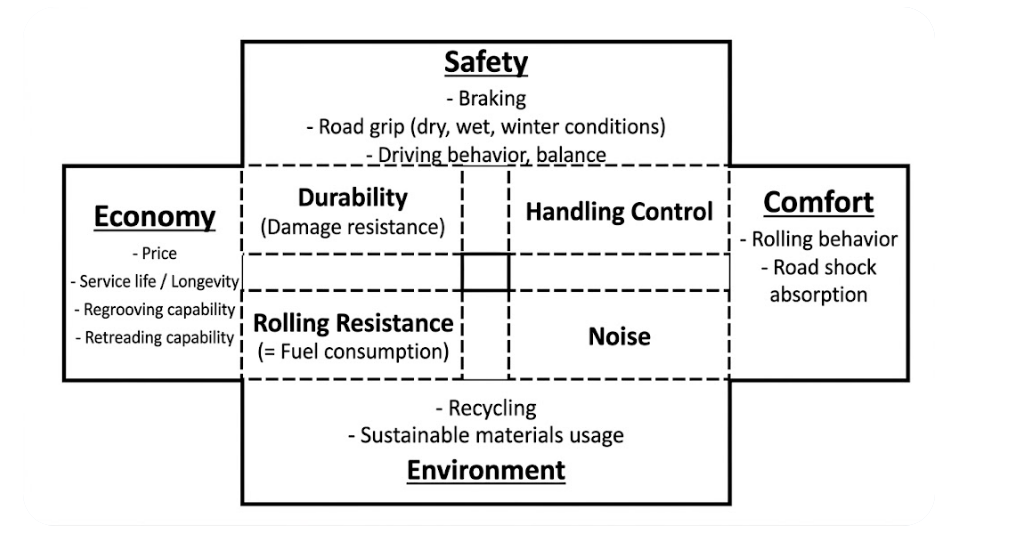
As a result, specific tire characteristics are optimized: higher load capacity and improved wear resistance become key selling points. But this often comes with trade-offs.
Factors such as traction, fuel efficiency, ride comfort, and overall driving stability may receive less attention, as they are harder to measure and less visible in short-term decision-making.
Over time, this creates a feedback loop. Market demand shapes product design, and product availability reinforces buying behavior.
In that sense, the truck tire is no longer just an engineering product — it is a direct reflection of how the market chooses to operate.
How to Measure Real Truck Tire Cost
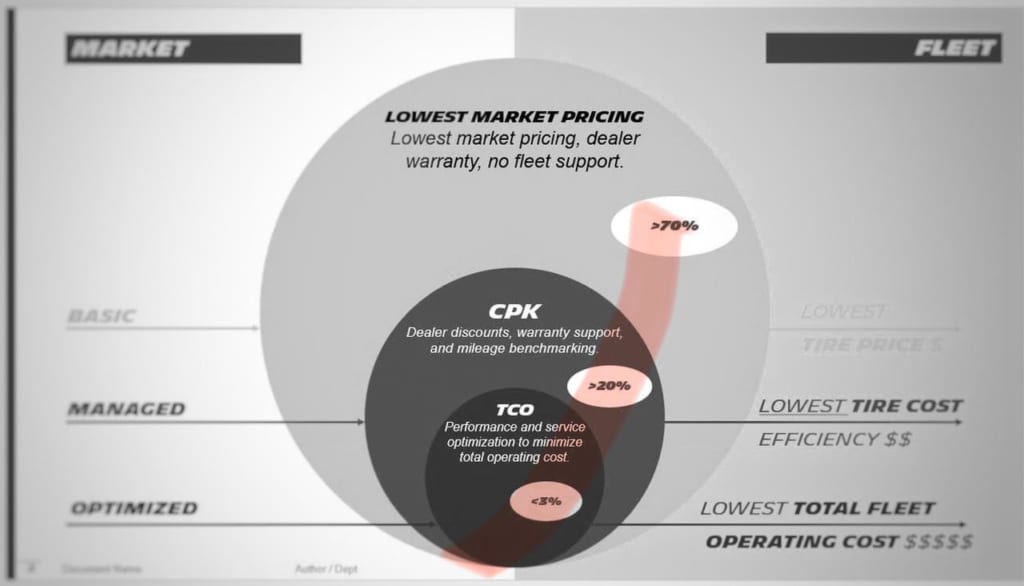
Cost Per Kilometer (CPK): The Simplest Way to Measure Tire Cost
If price does not reflect real tire cost, then how should it be measured?
Cost Per Kilometer (CPK) is one of the simplest ways to understand tire performance. Instead of focusing on how much a tire costs upfront, it looks at how much value the tire delivers over distance.
In theory, this is straightforward. Drivers only need to record the mileage when a tire is installed and track how many kilometers it runs before replacement.
But in reality, this step is often skipped. Most drivers do not track exact mileage. Instead, decisions are based on perception — how long the tire seemed to last, or how much time passed between replacements.
When distance is not measured, performance cannot be compared. And without comparison, cost cannot be evaluated accurately.
This is why, even though CPK is simple, it is rarely applied consistently in practice. And when measurement is missing, decisions naturally fall back to price — not because it is the most accurate metric, but because it is the only one available.
In the end, understanding tire cost comes down to a simple idea:
At this level, if mechanical issues or wheel alignment problems cause a tire to be removed early, the responsibility is often placed on the tire itself — rather than the system affecting its performance.
Total Cost of Ownership (TCO): The Cost You Don’t See at Purchase
Cost Per Kilometer (CPK) helps measure tire performance over distance.
But it still looks at the tire in isolation.
Total Cost of Ownership (TCO) goes further. It considers how a tire affects the entire vehicle — including fuel consumption, maintenance, downtime, and driving safety.
One of the most critical factors within TCO is rolling resistance (RR).
Lower rolling resistance means the tire requires less energy to move, directly reducing fuel consumption over long distances. In a context where fuel prices have increased significantly — and are expected to remain volatile or elevated — this factor becomes even more important. For fleets operating thousands of kilometers each month, even a small difference in RR can translate into substantial and recurring cost savings.
However, not all tires are designed with this balance in mind.
In many markets, including Vietnam, demand often prioritizes higher load capacity and stronger wear resistance. As a result, tires are optimized to carry more weight and last longer in terms of tread life.
But this optimization comes with trade-offs.
Higher load-focused designs and harder compounds can increase rolling resistance, leading to higher fuel consumption over time. At the same time, these tires may generate more heat, transmit more vibration, and place additional stress on suspension and steering components.
This is where hidden costs begin to appear.
Increased vibration and reduced flexibility can accelerate wear on mechanical parts such as bushings, shock absorbers, and steering systems. What seems like a durable tire may, in reality, contribute to higher maintenance costs across the vehicle.
Driving feel also plays a critical role.
A tire that provides better grip, stability, and responsiveness improves vehicle control — especially under braking, cornering, or wet conditions. This directly impacts safety, reduces driver fatigue, and lowers the risk of irregular wear caused by poor handling.
In contrast, when these factors are overlooked, the cost is not immediately visible — but it accumulates over time through fuel, maintenance, and operational risk.
In that sense, TCO is not about buying a tire.
It is about understanding how that tire interacts with the entire system.
Who Is Responsible for Changing This — And What Should Be Done?
Drivers are not the problem.
They operate under real pressure — cost, time, and uncertainty. Choosing based on price is not wrong. It is the only logical decision when price is the only clear metric available.
The real problem is the system behind the decision.
When performance is not measured, when data is not visible, and when support is inconsistent, price becomes the default. Not because it is correct — but because it is the only thing that can be compared.
So responsibility does not sit with the driver.
It sits with those who shape the system.
For Tier 1 tire manufacturers and dealer networks, this is not just a business question — it is a responsibility to the market.
If the goal is to create real value, not just move volume, then the role must change.
- From selling tires → to managing performance.
- From reacting to failure → to preventing it.
- From quoting price → to proving cost.
That means:
Making CPK measurable in real operations
Turning TCO into something fleets can actually see
Providing consistent, system-driven service — not experience-based fixes
Because without measurement, there is no control.
And without control, cost is left to chance.
In the end, the market will not change because drivers think differently.
It will change when they are given something better to measure.
And whoever provides that — will lead it.
Not always. A lower purchase price may reduce short-term spending, but higher fuel consumption, faster wear, casing failure, and unexpected downtime can quickly erase the initial savings.
No. The purchase price is only the visible cost. Real tire cost also includes fuel efficiency, tire lifespan, maintenance, downtime, and how the tire affects the entire vehicle over time.
Yes — especially in long-haul operations. Even small increases in rolling resistance can significantly raise annual fuel expenses when trucks operate thousands of kilometers every month.
Because price is easy to compare. Fuel efficiency, casing durability, and long-term operating cost are much harder to measure consistently, so fleets often fall back to the clearest number available: upfront price.
No. A tire may deliver long tread life but still increase fuel consumption, vibration, maintenance cost, or casing failure risk. Mileage matters — but it does not tell the full story of fleet operating cost.
Nhat Diem Honq

