

Sai Gon, 15 Mar 2026. Steer axle tires are the most visible tires on a truck — and often the most complained about. When drivers or fleet managers notice uneven wear, vibration, or rapid tread loss on the front axle, the first reaction is frequently the same: the tire quality must be the problem.
In reality, steer axle truck tires operate under a combination of vertical load and lateral steering forces that other tire positions rarely experience in the same way. While drive tires mainly transmit torque and trailer tires primarily carry load, steer tires must support the front weight of the vehicle while translating every steering input into directional control. Braking forces, small steering corrections, and the natural crown of the road are all transmitted directly through the two tires on the steer axle.
Because of this stress concentration, steer tires are often the first tires to reveal underlying mechanical or operational issues. When irregular wear, vibration, or rapid tread loss appears, fleets frequently remove steer axle truck tires earlier than planned to avoid steering instability or safety risks. This early removal creates two immediate cost challenges: tires that still have usable tread must either be replaced prematurely or moved to another axle position, and the original tire rotation plan across the fleet is disrupted.
The key question then becomes whether the wear is simply normal tread progression or the result of an external factor. Slow, even wear across the tread usually reflects normal service, while rapid or localized patterns—such as one-sided shoulder wear, feathering, or cupping—often signal problems with alignment, suspension components, or inflation pressure.
What Are Steer Axle Truck Tires?
Steer axle truck tires are the tires mounted on the front axle of a commercial truck. Their primary role is to guide the vehicle and translate steering inputs from the steering wheel into directional control on the road. Unlike drive tires that mainly transmit torque or trailer tires that primarily carry load, steer tires combine load-bearing responsibility with vehicle guidance, making them one of the most critical tire positions on a truck.
However, what drivers and fleet managers see on the outside is only a small part of the story. The visible role of steer tires—controlling direction and supporting the front axle—is just the surface of a much more complex mechanical reality that unfolds as the vehicle moves.
During operation, steer axle truck tires are constantly exposed to dynamic loading conditions. As the truck enters a curve, the tires must resist lateral forces that push the tread sideways across the road surface. When the driver makes small steering corrections or changes lanes, the tire’s contact patch subtly deforms to accommodate shifting loads. Even on a straight highway, the natural crown of the road creates a continuous side force that the steer tires must counter to keep the vehicle tracking straight.
Braking introduces another layer of stress. As the vehicle decelerates, weight transfers toward the front axle, increasing vertical load while the tread simultaneously absorbs longitudinal braking forces. These combined stresses—vertical load, lateral steering force, and longitudinal braking force—are repeatedly concentrated on the two steer tires.
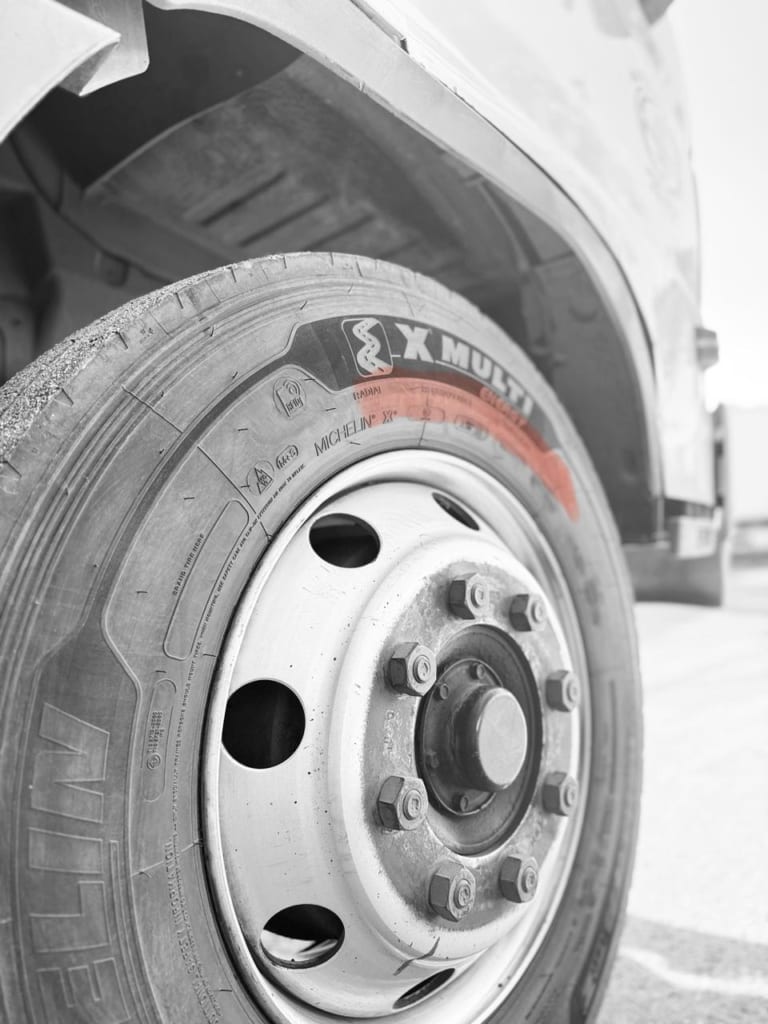
Because steer tires operate under constantly changing vertical, lateral, and braking forces, the tread surface often becomes a visible record of how the vehicle behaves on the road. Small deviations in alignment, suspension geometry, or inflation pressure gradually alter how forces are distributed across the contact patch. Over thousands of kilometers, these small mechanical differences leave distinct wear patterns on the tread. As a result, the steer axle is often the first place where underlying vehicle issues become visible, long before they are detected during routine maintenance.
Why Steer Tires Wear Differently From Other Truck Tires
Steer tires operate under a different set of forces than drive or trailer tires. In addition to supporting the front axle load, they must constantly respond to steering inputs and keep the truck tracking in the intended direction. This dual role—carrying weight while guiding the vehicle—exposes steer tires to more complex stresses during everyday operation.
Two groups of factors largely determine how these stresses accumulate: external operating conditions and tire design characteristics.
External Factors: Driving Behavior, Road Conditions, and Vehicle Setup
Steer axle truck tires operate under constantly changing forces during daily operation. Unlike other tire positions, the steer axle must both support the front axle load and translate steering input into directional control. As a result, small changes in driving behavior, road conditions, or vehicle setup can gradually alter how pressure is distributed across the tire’s contact patch.
Driving Behavior
Driver behavior directly influences how lateral and longitudinal forces act on steer tires. Frequent steering corrections and repeated lane changes push the tread slightly sideways against the road surface, gradually shifting pressure across the tread ribs. Over time, this movement can lead to uneven wear patterns such as feathering or rib edge wear.
Acceleration and braking also affect how loads move across the tire. Sudden acceleration briefly reduces load on the front axle, while hard braking transfers additional weight onto the steer tires. When this load transfer happens repeatedly—such as in stop-and-go traffic or aggressive driving—the contact patch experiences continuous pressure variation, increasing stress across the tread and accelerating irregular wear.
Higher speeds further amplify these effects. As speed increases, tread flexing and internal heat buildup rise, making the tire more sensitive to steering forces and small road surface disturbances.
Road and Operating Conditions
Road conditions also play an important role in how forces accumulate on steer tires. Pavement texture, surface irregularities, and small bumps continuously disturb the tire’s contact patch as the vehicle moves. These small disturbances gradually shift pressure across the tread ribs and can contribute to wear patterns such as cupping or localized tread stress.
Highway geometry introduces another constant influence. Most roads are built with a slight crown for drainage, which naturally pushes the vehicle outward. To maintain a straight path, steer tires must continuously generate a small counteracting force. Over long distances, this persistent side force can concentrate stress toward one side of the tread and contribute to outer shoulder wear.
Vehicle Condition and Load Distribution
The mechanical condition of the vehicle also determines how these forces reach the tire. When the front axle carries more load than intended—due to cargo placement or additional equipment—the contact patch must support higher pressure, increasing stress on the tread.
Steering and suspension alignment are equally critical. If the tire cannot roll perfectly straight because of misalignment, the tread begins to scrub slightly against the road surface during each rotation. Over time, this repeated scrubbing can produce feathering or one-sided wear. Worn suspension components or weak shock absorbers may also allow the tire to bounce more over uneven pavement, increasing load fluctuation and contributing to cupping.
Because steer tires respond directly to driver input, road conditions, and vehicle dynamics, they are often the first tires to reveal how the truck is being driven and how well its mechanical systems are performing.
Internal Factors: Tire Setup and Design
Inflation Pressure
Inflation pressure is the most critical internal factor influencing steer tire performance because it determines how load is distributed across the contact patch. On the steer axle—where the tires both support the front axle load and control the vehicle’s direction—correct pressure allows the tread ribs to share forces evenly and maintain stable steering response. Unlike most drive axles, which use dual tires that can partially share load if one tire loses pressure, steer axles typically rely on single tires on each side, making proper inflation even more critical for safety.
When inflation pressure drops below the recommended level, the contact patch expands and more load shifts toward the shoulder ribs. Under continuous steering inputs and road crown forces, this imbalance accelerates irregular wear such as shoulder wear or feathering while increasing heat buildup inside the casing. As the structure weakens, the risk of tire failure rises. On a steer axle, such a failure can immediately affect vehicle direction because there is no second tire beside it to help stabilize the load.
Excessively high pressure creates the opposite problem. The contact patch becomes narrower and load concentrates near the center ribs, reducing the tire’s ability to maintain consistent grip on the road surface. During braking—especially on wet or uneven pavement—the smaller contact area increases the risk of front-axle slip during hard braking. Because steer tires are responsible for directional control under braking, any loss of traction at the front axle can quickly compromise steering stability and overall vehicle safety.
Tire Profile and Contact Patch Geometry
Tire profile also influences the shape and behavior of the contact patch on steer axle truck tires. Traditional sizes such as 12R22.5 use a taller sidewall that allows the tire structure to flex more as it rolls under load. This flexibility helps the contact patch adapt gradually to steering inputs, road irregularities, and load changes, distributing pressure more progressively across the tread ribs.
Low-profile sizes such as 295/80R22.5 or 275/80R22.5, by comparison, use a shorter sidewall and typically produce a wider, shorter contact patch. The broader footprint improves braking performance because a larger portion of the tread remains in contact with the road during deceleration. This wider contact area also allows tire manufacturers to optimize tread compounds for lower rolling resistance while maintaining adequate traction, helping balance fuel efficiency with braking stability.
However, the shorter sidewall also makes the tire structure stiffer. As a result, when lateral forces act on the steer axle—during steering inputs, lane changes, or when counteracting road crown—the contact patch deforms less gradually than it would on a taller-profile tire. Instead, pressure can shift more abruptly across the tread ribs. Over time, this sharper pressure movement increases localized stress along rib edges, making wear patterns such as feathering or rib edge wear more likely to appear earlier when alignment, inflation pressure, or suspension conditions are not well controlled.
Common Steer Tire Wear Patterns and Early Diagnosis
Steer axle truck tires can develop several characteristic wear patterns during operation. Because these tires carry the front axle load while responding to steering inputs and braking forces, even small changes in force distribution across the contact patch can gradually produce visible tread irregularities.
Common patterns include shoulder wear, feathering, cupping, and one-sided tread wear. Each pattern often reflects how forces are acting on the tire—whether from alignment deviation, suspension movement, inflation pressure imbalance, or repeated steering inputs.
For fleet maintenance teams, these wear patterns often serve as early indicators of how the vehicle’s steering and suspension systems are performing. Regular tread inspection can help identify potential mechanical issues before they lead to more severe tire damage or steering instability.
How to Extend Steer Tire Life
Extending the service life of steer axle truck tires depends largely on how evenly forces are distributed across the contact patch. Because steer tires carry the front axle load while translating every steering input into vehicle direction, even small deviations in inflation pressure or alignment can quickly accelerate irregular wear.
Maintaining correct inflation pressure is the first priority. Proper pressure allows the tread ribs to share load evenly and maintain stable steering response. Most fleets determine the correct pressure using a truck tire pressure chart, which matches tire load with the minimum inflation pressure required to support it safely. Running below this pressure shifts stress toward the shoulders and increases heat buildup, while excessive pressure concentrates load in the center ribs and reduces braking grip.
Wheel alignment and suspension condition are equally important. When toe or camber angles deviate from specification, the tread begins to scrub slightly against the road surface during each rotation, gradually producing feathering or one-sided wear. Regular inspections ensure the tire rolls straight and prevent small alignment errors from gradually destroying the tread, allowing steer tires to wear more gradually and predictably over time.
When Should Steer Tires Be Replaced or Rotated
Steer tires are often removed earlier than tires in other axle positions because they directly influence steering stability and braking control. When irregular wear begins to affect how the truck tracks on the road—such as vibration in the steering wheel, pulling to one side, or visible shoulder wear—the safest decision is usually to remove the tire from the steer position.
Early Warning Signs Drivers Should Watch
For large fleets, this decision is typically guided by maintenance inspections and tread depth monitoring. Technicians analyze wear patterns and determine whether the tire should be replaced or rotated to another axle position while the remaining tread can still be used safely.
For small fleets or owner-operators, however, the earliest warning signs usually come directly from the driver. Changes in steering feel—such as increased vibration, subtle pulling, or unusual tread patterns during routine visual checks—often appear long before the tire reaches its wear limit. Paying attention to these signals allows drivers to identify alignment or suspension problems early and rotate the tire before irregular wear becomes severe.
In many cases, steer tires that are removed early still have usable tread and can continue operating on drive or trailer axles, where the stresses are different. In this way, the steer tire does not simply wear out—it often becomes the first indicator that something in the truck’s mechanical system has changed.
On many trucks, the driver feels the problem before the maintenance team sees it — and the steer tire is usually where it first becomes visible.
Tire Selection: Balancing CPK and TCO
When selecting truck tires, drivers and fleet operators often balance two different cost perspectives: cost per kilometer (CPK) and total cost of ownership (TCO). Some tires are designed primarily for long tread life, helping reduce replacement frequency and lowering the direct tire cost per kilometer. Others focus more on lower rolling resistance, which can reduce fuel consumption over long highway operations but may wear faster depending on route conditions and driving style.
For steer axle truck tires, however, the decision criteria are often slightly different. Because the steer axle directly affects vehicle control, braking stability, and wear sensitivity, drivers typically prioritize traction stability and resistance to irregular wear rather than maximum mileage or fuel efficiency alone. A steer tire that maintains consistent contact pressure and stable tread wear helps preserve steering control and makes it easier to detect early signs of alignment or suspension issues.
Fuel-efficient tires with lower rolling resistance can still play an important role in overall operating cost, but they are often better suited to drive or trailer axles, where fuel savings can accumulate over long distances and the tires are less sensitive to steering-related wear patterns.
For this reason, many fleets and experienced drivers treat the steer axle differently from the rest of the vehicle: the front tires are selected primarily for control, stability, and predictable wear, while tires optimized for fuel efficiency or extended mileage are more commonly used on other axle positions.
Because the steer axle reacts directly to steering forces and vehicle dynamics, the behavior of the front tires often provides the earliest clues about how well the truck’s mechanical systems are functioning.
For this reason, experienced drivers often treat steer tire wear as an early diagnostic signal of the truck’s mechanical condition.
With modern premium tires, this role becomes even more pronounced. Because their tread design, casing stability, and compound consistency allow forces to distribute more predictably across the contact patch, small changes in alignment, suspension geometry, or inflation pressure tend to appear earlier in the wear pattern. In this sense, premium steer tires often function like a mechanical sensor for vehicle condition, revealing subtle problems before they develop into larger maintenance issues.
Nhat Diem Honq

