

When people discuss premium truck tires, they often focus on one question:
“How many kilometers can this tire last?”
Michelin approaches the question differently.
Rather than asking how long a tire can last, its engineers ask how long a tire can maintain vehicle control, structural integrity, and safety under changing loads, braking forces, cornering, and road temperatures.
That philosophy is reflected in the Michelin X Multi Z2, a regional steer tire engineered around the concept of “Safer for Longer.” Instead of chasing mileage alone, Michelin focuses on preserving steering precision, wet grip, and casing durability throughout the tire’s entire service life.
Michelin X Multi Z2 Specifications and Available Sizes
The Michelin X Multi Z2 is designed as a premium regional steer tire for commercial trucks operating on highways, regional roads, and mixed transport routes. Depending on the market, it is available in several sizes to accommodate different axle loads and vehicle configurations.
| Dimension | LI/SS | PR | Recommended Rim (INCHES) |
Measuring Rim |
Original Tread Depth (mm) |
Overall Diameter (mm) |
Tread Width (mm) |
Regroove Depth |
|---|---|---|---|---|---|---|---|---|
| 11R22.5 X MULTI Z2 | 148/145L | 16 | 7.50 – 8.25 | 8.25 | 14.5 | 1045 | 217 | 3 |
| 12R22.5 X MULTI Z2** | 152/149L | 18 | 8.25 | 9 | 14.5 | 1076 | 235 | 2.5 |
| 295/80 R22.5 X MULTI Z2 | 152/149M | 18 | 8.25 | 8.25 | 14.9 | 1045 | 245 | 3 |
The Michelin X Multi Z2 carries a 152/149M rating, which increases to 154/150L when operated at the lower L speed rating (120 km/h).
Typical Applications
The Michelin X Multi Z2 is designed for fleets operating on regional roads, highways, and mixed transport routes. It is commonly used on tractors, rigid trucks, tanker fleets, refrigerated transport, and distribution vehicles where steering precision, casing durability, and long service life are essential.
Michelin X Multi Z2 Is Engineered for Steering Precision
Unlike drive axle tires that primarily transmit engine torque, steer tires perform three critical functions simultaneously:
- Carry heavy vertical loads
- Generate steering forces
- Absorb braking forces
Every steering input creates lateral deformation within the tread.
Every braking event transfers additional weight onto the front axle.
Every road imperfection generates cyclic stress throughout the casing.
A steer tire must withstand these repeated forces while maintaining a stable footprint.
This is why steer tires often develop different wear patterns from drive tires.
For Michelin, maintaining steering precision throughout the tire’s life is more important than simply maximizing tread mileage.
How Michelin X Multi Z2 Maintains a Stable Contact Patch
Many fleet operators monitor tread depth.
Far fewer understand the importance of the contact patch.
The contact patch is the only portion of the truck actually touching the road.
Everything happens here:
- Steering
- Braking
- Cornering
- Traction
- Heat generation
- Rolling resistance
The goal of tire engineering is straightforward:
Maintain the most uniform pressure distribution possible across the contact patch.
Uneven pressure creates localized stress that leads to:
- Shoulder wear
- Center wear
- Heel-and-toe wear
- Feathering
- Heat build-up
- Increased rolling resistance
Michelin optimizes the tread profile of the X Multi Z2 to distribute loads evenly across the footprint, helping reduce irregular wear while maintaining predictable steering response.
Four Technologies Working Behind the Contact Patch
Maintaining a stable footprint is not achieved through tread pattern alone.
The Michelin X Multi Z2 combines four complementary technologies that work together throughout the tire’s life.
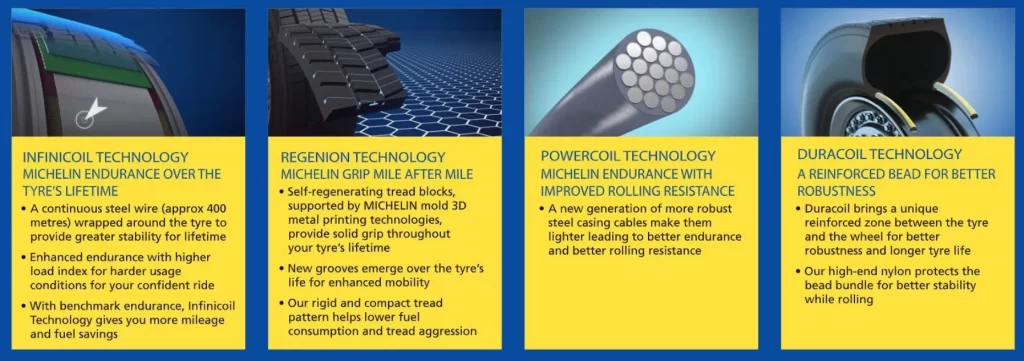
REGENION Technology
Unlike conventional tread patterns that gradually lose their biting edges, REGENION Technology continuously reveals new grooves as the tread wears.
The result is improved wet grip and steering performance even after significant tread wear.
Instead of delivering maximum traction only when new, the tire maintains performance over a much larger portion of its service life.
Matrix Siping
Michelin also incorporates Matrix Siping, a network of three-dimensional sipes that increase the number of biting edges while limiting excessive tread block movement.
This allows the tire to improve braking and wet traction without compromising tread stability or wear resistance.
Powercoil Technology
One of the most significant structural innovations is Powercoil Technology.
Instead of conventional steel reinforcement, Michelin uses a continuous high-tensile steel cable wrapped around the casing.
This improves casing rigidity, reduces structural deformation under heavy loads, minimizes heat generation, and helps extend casing life.
Duracoil Technology
The bead area is one of the most highly stressed parts of any truck tire.
Michelin reinforces this critical zone using Duracoil Technology, adding a protective nylon layer around the bead to improve endurance during repeated mounting, heavy loading, and long-distance operation.
The result is improved bead durability and better protection of the casing for future retreading.
How Michelin X Multi Z2 Reduces Heat Build-Up
Truck tires rarely fail because they become old.
They fail because excessive heat slowly damages rubber compounds and steel reinforcements.
Heat is generated every time the tire flexes.
The greater the sidewall deformation, the greater the heat build-up.
Several operating conditions accelerate this process:
- Underinflation
- Overloading
- High ambient temperatures
- High operating speeds
- Aggressive braking
- Poor wheel alignment
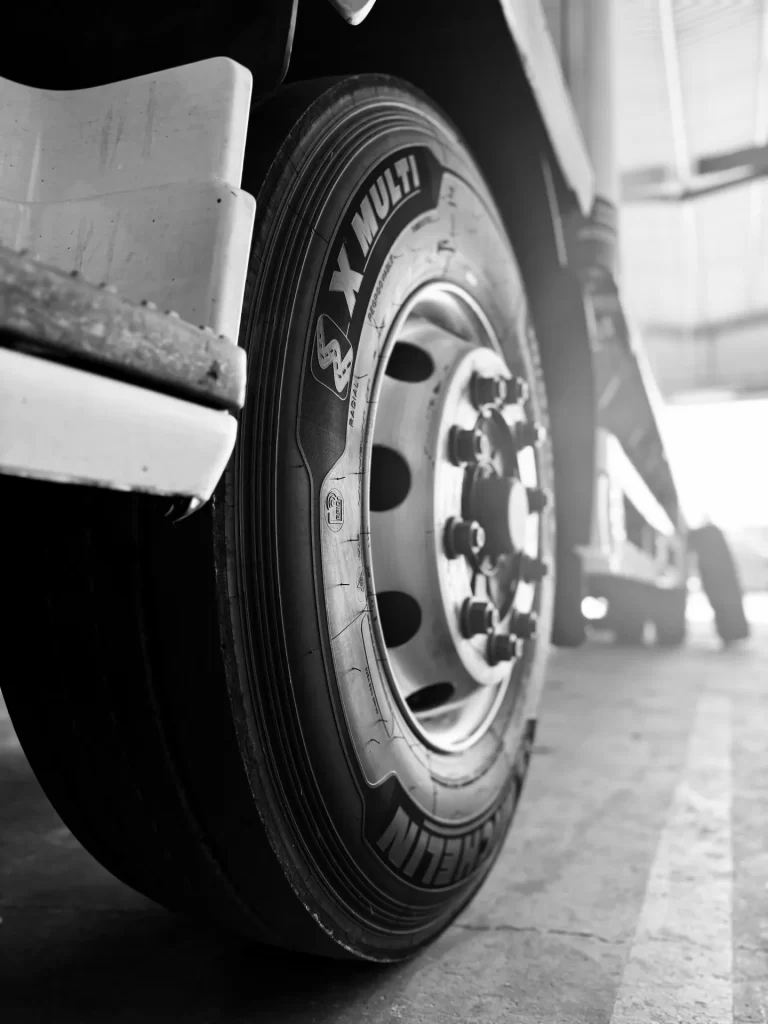
Michelin’s casing architecture, reinforced by Powercoil Technology, helps minimize unnecessary deformation under load.
Less deformation means:
- Lower operating temperatures
- Slower rubber aging
- Reduced casing fatigue
- Longer structural durability
The X Multi Z2 also features reinforced tread plies that help resist impacts, slow crack propagation, and reduce the likelihood of sudden pressure loss following tread damage, providing valuable additional time for drivers to maintain control in emergency situations.
Engineering the Tire From the Bead Up
Most people only see the tread.
Engineers spend just as much time designing the bead, where the tire interfaces with the wheel.
The bead experiences enormous cyclic stress from:
- Vehicle load
- Steering forces
- Braking forces
- Wheel torque
- High operating temperatures
Over hundreds of thousands of kilometers, fatigue in this area can eventually compromise casing integrity.
Michelin addresses this through Duracoil Technology, reinforcing the bead with nylon protection that improves resistance to fatigue, reduces damage during mounting and demounting, and helps preserve one of the tire’s most valuable assets—its casing.
Rolling Resistance and Fuel Efficiency in Michelin X Multi Z2
Every time a tire rotates, its rubber compounds compress and rebound.
This repeated deformation consumes energy through a phenomenon known as hysteresis.
Lower hysteresis means lower rolling resistance.
However, reducing hysteresis alone is not enough.
A tire optimized only for fuel efficiency may sacrifice grip, while one designed purely for traction may wear faster.
Michelin balances these competing requirements by optimizing:
- Fuel efficiency
- Wet grip
- Wear resistance
- Structural durability
The result is a steer tire capable of delivering predictable performance throughout its operating life rather than excelling in only one performance category.
Why Michelin X Multi Z2 Delivers Lower Cost Per Kilometer
One of the most interesting aspects of Michelin’s philosophy is what it chooses not to emphasize.
Rather than promoting the X Multi Z2 simply as a long-mileage tire, Michelin highlights:
- Safer handling
- Vehicle control
- Structural durability
- Pressure retention
- Fleet safety
- Lower cost per kilometer
The reasoning is simple.
When a tire maintains its contact patch, generates less heat, preserves casing integrity, and continues to deliver reliable grip throughout its life, long mileage becomes a natural consequence rather than the primary engineering target.
This systems approach aligns closely with modern fleet management, where success is measured by cost per kilometer instead of purchase price.
Takeaway
Modern truck tires are no longer just rubber products.
They are engineered systems that integrate tread design, compound chemistry, casing architecture, bead reinforcement, and structural engineering into a single solution.
The Michelin X Multi Z2 demonstrates this philosophy through technologies such as REGENION, Matrix Siping, Powercoil, and Duracoil, all working together to maintain vehicle control, reduce heat, protect the casing, and extend usable tire life.
Ultimately, the true value of a premium truck tire is not measured by how many kilometers it can travel, but by how consistently it delivers safety, reliability, and predictable operating costs throughout its entire service life.
Frequently Asked Questions
The Michelin X Multi Z2 combines multiple engineering technologies—including REGENION, Matrix Siping, Powercoil, and Duracoil—to maintain steering precision, improve wet grip, reduce heat build-up, and extend casing life. Instead of focusing only on tread mileage, Michelin designs the tire to deliver consistent safety and performance throughout its service life.
REGENION Technology gradually reveals new grooves as the tread wears. This self-regenerating tread pattern helps maintain wet traction, braking performance, and steering stability even after significant tread wear, allowing the tire to remain safer for longer.
Powercoil Technology uses a continuous high-tensile steel cable to reinforce the casing. This construction reduces structural deformation under heavy loads, lowers heat generation, improves stability, and extends casing durability, making the tire more suitable for retreading.
A durable casing allows the tire to withstand heavy loads, repeated heat cycles, and long-distance operation while remaining suitable for regrooving and retreading. For fleets, protecting the casing helps reduce the total cost per kilometer and increases the overall value of the tire.
Not entirely. Michelin’s engineering philosophy emphasizes “Safer for Longer” rather than simply maximizing mileage. By maintaining a stable contact patch, reducing heat build-up, preserving casing integrity, and improving vehicle control, longer tire life becomes the result of better engineering rather than the primary objective.
Nhat Diem Honq

